
What is the Agent2Agent protocol?
The A2A protocol is an open-source standard that specifies how multiple agents should communicate with each other. Google introduced this open protocol in April 2025.
What is meant by agent-to-agent?
A2A generally refers to the “agent-to-agent” principle: two (or more) AI agents work together, exchange context, divide tasks, and coordinate results, often across system, team, or provider boundaries. Companies use autonomous agents to make processes faster, more efficient, and automated. The Agent2Agent protocol (A2A protocol), on the other hand, is the specific, open standard that functions as a communication protocol for artificial intelligence (AI) agents. It enables interoperability between AI agents from different providers or between different AI agent frameworks and was developed for multi-agent systems. A2A can be thought of as a universal translator for agent ecosystems. The goal is to reduce silos and improve agent interaction.
How does A2A work?
AI agents need a common understanding of who does what, how they coordinate, and how they exchange results. The A2A protocol is, so to speak, the overarching language that enables this collaboration without having to program each connection individually. It facilitates the creation of complex automation and workflow scenarios. We explain exactly how this works.
What components does the A2A protocol have?
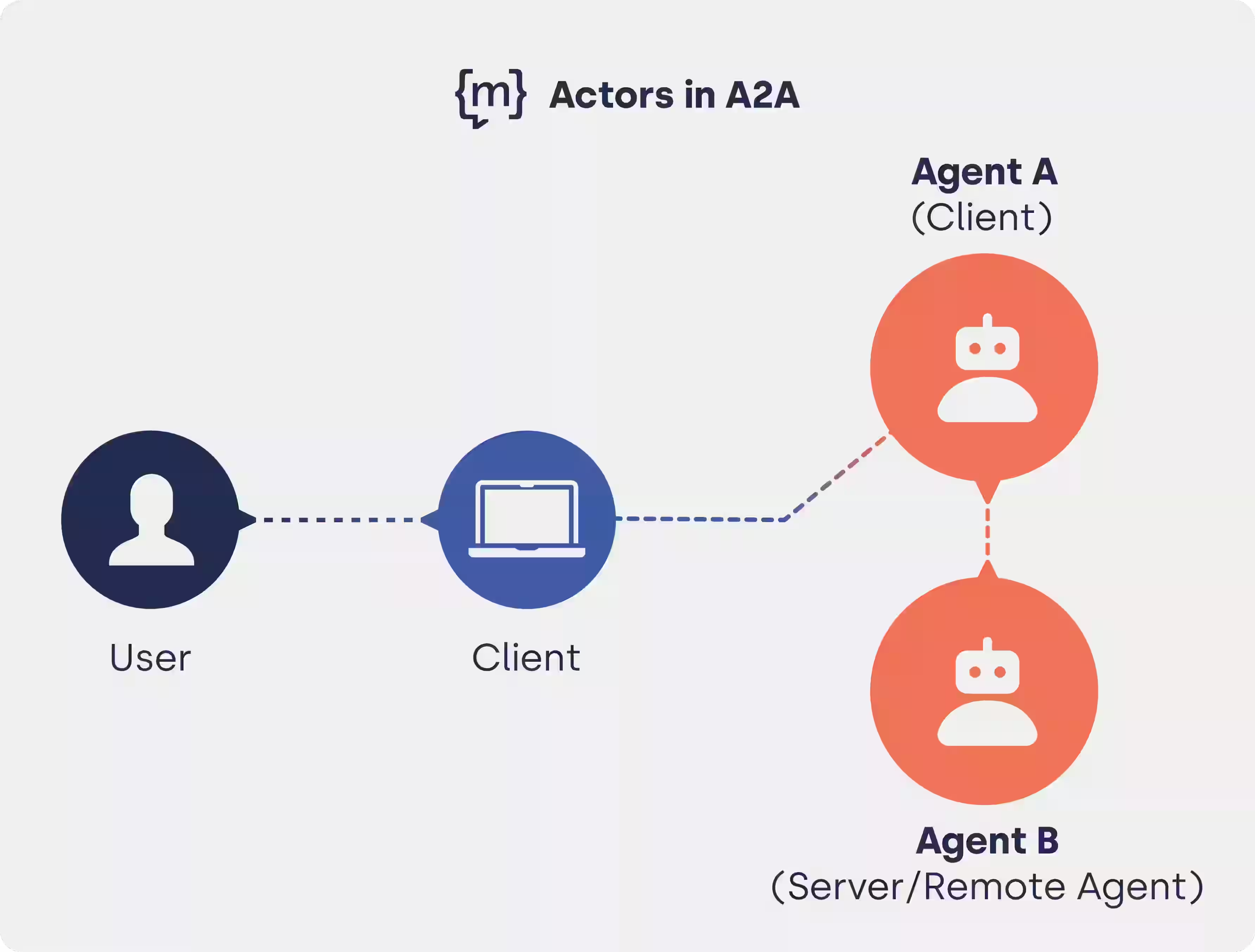
The Agent2Agent (A2A) protocol involves three main actors for interactions: the user, the A2A client, and the A2A server.
The user is the end user and can be a human operator or an automated service. They initiate a request or define a goal that requires the support of one or more AI agents.
The A2A client, also known as the client agent, is an application, service, or another AI agent that acts on behalf of the user. It initiates communication via the A2A protocol and forwards requests to the responsible agent.
The A2A server, also known as the remote agent, provides an HTTP endpoint for implementing the A2A protocol. It receives the requests, processes the tasks, and returns results or new status messages.
From the client's perspective, the remote agent acts similarly to a black box: internal processes, memory, or tools used are not visible, ensuring a clear separation between the interface and implementation.
The A2A design principles
The A2A protocol is based on five key principles to enable effective collaboration between agents and enable them to solve tasks together:
- Accepting agent capabilities: Each agent shares its capabilities via the Agent Card in JSON format, a kind of business card, so that tasks can be specifically assigned and accessed by other agents.
- Building on existing standards: The protocol is based on existing standards such as HTTP, SSE, and JSON-RPC, which simplifies integration into existing IT stacks for companies.
- Secure and flexible communication: Communication takes place via web standards and also supports asynchronous or longer processes as well as corporate authentication and authorization.
- Coordinating tasks: Overall tasks are divided into subtasks and processed by the agents; the protocol defines the "task" object. The agent's response can be a new task or a direct message.
- Modality-agnostic: The A2A protocol supports various content types such as text, forms, and files, as well as the processing of audio and video streams.
An agent card describes the identity, endpoint, capabilities, and authentication requirements of the remote agent. Key objects are
- Tasks (stateful work units),
- Messages (individual communication rounds with the role "user"/"agent"), and
- Parts as containers for content such as text, files, or JSON data.
Artifacts are the actual, structurally retrievable results of a task. For communication, A2A supports synchronous request/response with polling, streaming via server-sent events, and asynchronous push webhooks for long or interrupted processes.
What are the advantages of the A2A protocol?
“A2A has the potential to unlock a new era of agent interoperability, fostering innovation and creating more powerful and versatile agentic systems” - Google for Developers, April 2025
As an open-source protocol, developers can directly access the protocol and contribute their expertise in data management and workflow orchestration to further develop A2A. Companies benefit significantly from the standardized method across various platforms and cloud environments. Agent discovery, coordination, and communication enable seamless delegation and collaboration, allowing for better workflow automation, reduced costs, and reliable AI outcomes. At the same time, enterprise-grade security, trusted interactions, and user-friendliness are ensured. The A2A protocol is designed to be flexible and extensible, allowing it to be seamlessly adapted to new use cases and technologies.

Specific examples of Agent2Agent in customer communication
Agent-to-agent communication represents an innovative development in customer interaction, whereby different agents work together on complex inquiries and delegate tasks appropriately. The customer receives real-time updates throughout the entire process. This increases efficiency and accuracy in chatbots or support systems.
Here are a few examples illustrating A2A in customer communication:
1. Operational service automation through A2A
A customer contacts an AI agent with a request, which the agent recognizes and processes with the relevant context. A second agent is then prompted to retrieve the relevant contract or CRM data. A third agent initiates the appropriate action, such as creating a ticket or a suggested response. This results in clearly structured multi-agent workflows that process service requests faster and more consistently.
2. Analytical CX optimization
Agent2Agent workflows can support the continuous optimization of the customer experience. Multiple agents analyze customer feedback, identify recurring patterns, and cluster the corresponding pain points. Based on this, dialogue flows, content, or FAQ structures are further developed in a targeted manner without directly interfering with ongoing customer conversations.
3. Escalation in customer communication
A2A allows critical inquiries to be handled efficiently and contextually. If an issue with an increased risk of escalation is identified, for example through repeated complaints or abandoned chats, an AI agent checks the customer history and situational context. Another specialized agent then makes a decision about the optimal communication channel, prioritization, and possible transfer to a human agent. Escalations are thus managed proactively.
What is the difference between A2A and MCP?
MCP is the standard for connecting LLMs with data, resources, and tools.
A2A is an application-level protocol that enables agents to interact in their natural modalities.
Important to understand: A2A is intended to complement MCP, not compete with it. Both protocols use HTTP as the transport layer, support server-sent events for streaming responses, and rely on JSON-RPC for standardized communication. The difference lies in their focus: MCP connects agents with their structured tools, while A2A enables continuous communication and collaboration.
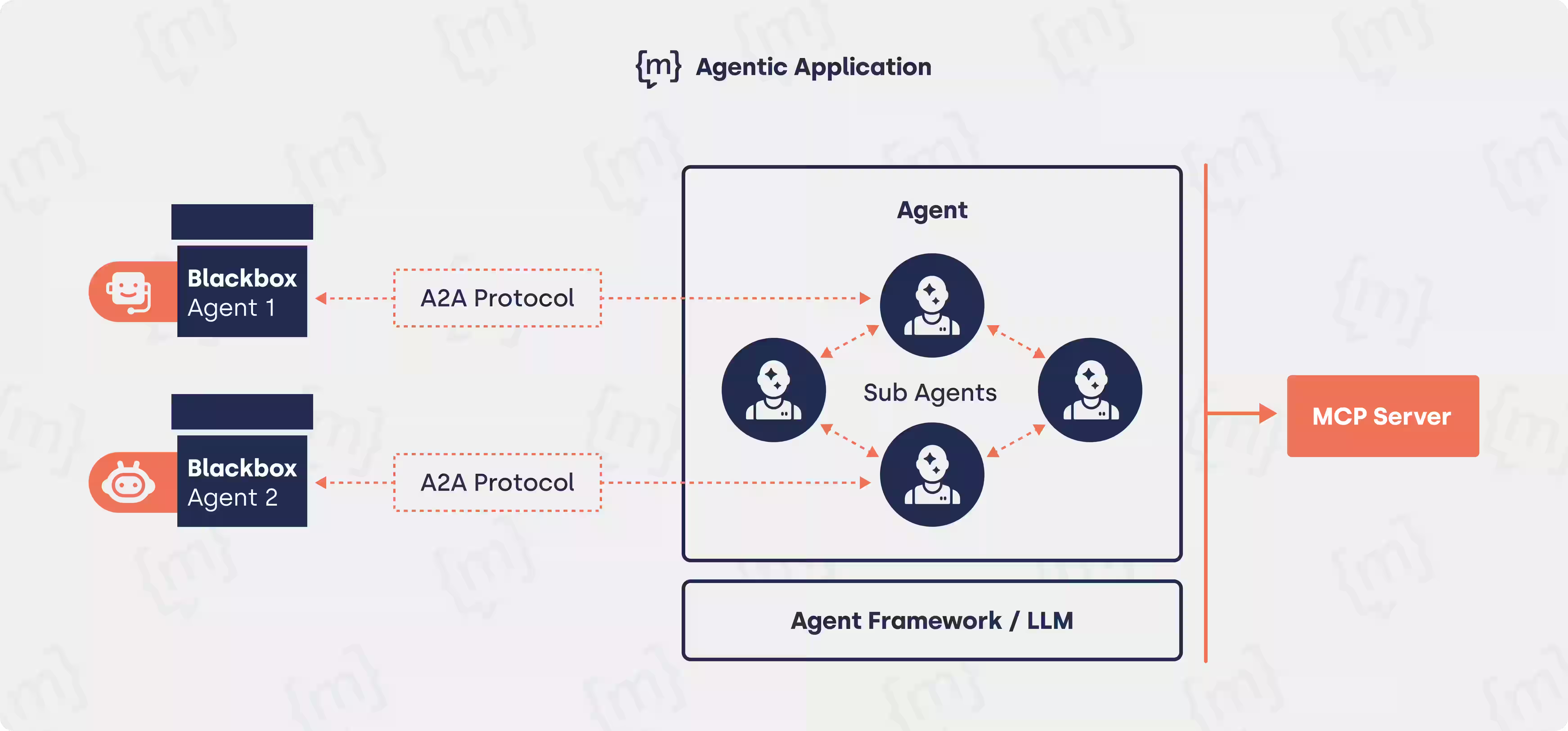
So when should A2A be used, and when should MCP be used? MCP is useful
- when one (or more) LLM agent(s) needs to access external resources in a structured manner (APIs, databases, files, internal tools)
- when tool and data integrations need to be standardized
- when contexts, sessions, and rights need to be managed cleanly (enterprise IT, governance, audits).
A2A, on the other hand, is used
- when multiple specialized agents need to cooperate and distribute tasks (orchestration, delegation, "agent calls agent")
- when providers of agent stacks need to be interoperable (multi-agent standard)
- when task lifecycle, streaming, and status updates between agents need to be managed (long-running tasks and complex workflows).
A2A Developments
The Agent2Agent protocol represents a significant advance in AI communication and promotes effective collaboration and problem-solving among AI agents. The protocol is a major step toward a more interconnected AI landscape and is crucial for the future design of intelligent systems and the development of their capabilities, particularly for flexible responsiveness to user needs. With growing adoption by leading AI platforms, it is becoming the standard for cross-vendor agent interactions. This means that agents from different vendors can exchange data. Extensions for multimodal content, improved security features, and integration with edge computing are expected in 2026.
A2A in use at moinAI
moinAI also uses an agent-based communication principle, in which one agent specifically calls on another for support. This principle is similar to the data exchange approach established by Google, but moinAI orchestrates its own agents, for example, when answers are generated and checked using the knowledge base: one agent formulates the answer, while another agent checks whether the underlying knowledge has been used correctly and appropriately. This creates a multi-level quality and consistency check between agents.
[[CTA headline="Unlock the full potential of intelligent AI agents with moinAI!" subline="See for yourself how AI agents measurably enhance the customer experience and optimize customer service." button="Try it now!"]]