


Definition: What Is an AI Chatbot?
An AI chatbot is a technical dialogue system that facilitates interaction between humans and technical systems. The conversation takes place via spoken language or in text form. An AI chatbot often offers the option of text input and output – usually via a so-called chat widget, also known as a chat window. As the name suggests, an AI chatbot is based on artificial intelligence and understands human language using, amongst other things, natural language processing (NLP). The system therefore not only processes predefined keywords, but also understands the user’s intention within their message.
Modern AI bots also often rely on large language models (LLMs) and learn from every interaction. They analyse queries, retrieve the relevant information from a central knowledge base, and provide responses that don’t sound robotic – but rather like a real conversation.
And it’s no longer just about FAQs. AI chatbots are taking on productive tasks: they offer advice, answer complex questions or provide recommendations – for example, by using specialised AI agents trained in specific subject areas. Whether in customer service, HR or e-commerce, AI chatbots can be deployed flexibly and relieve the workload on teams through automation, without compromising the user experience.
How Does an AI Chatbot Work?
Although there are many different chatbot solutions, their basic principle is usually similar: a user asks a question or raises an issue via a chat window – for example, on a website or in a messaging app such as WhatsApp or Facebook. The chatbot processes this input, identifies the underlying issue and provides an appropriate response.
However, there is clearly much more going on in the background than simply displaying a response:
Detecting input: The chatbot is triggered when a user types a message into the chat window or speaks into the voice input feature. Sometimes the chatbot is also triggered by other factors – such as an incoming email or a specific KPI value.
Understanding language and recognising intent: The AI chatbot then analyses the message and works out what it’s about. It understands not only the text but also the context – for example, whether the user needs help with a subscription or is looking for a product recommendation.
Processing and dialogue control: The chatbot now decides how the conversation proceeds. It takes the conversation history into account to provide responses that build logically on one another.
Finding and generating a response: The appropriate response is retrieved from a stored database or a central knowledge base – or generated dynamically using generative AI (GenAI). This enables the AI chatbot to answer even complex or new questions reliably.
Outputting the response: The response appears in the chat window – depending on the system, supplemented by buttons, images or other content. In some cases, the response is also provided via voice.
Learning and improving: After the conversation comes learning: the AI chatbot learns from every interaction. It analyses conversation flows, recognises patterns and continuously optimises its responses – entirely automatically. This makes it increasingly precise over time.
Modern AI chatbots are often connected to CRM, ERP or shop systems. This enables them to provide personalised information, initiate processes or take orders directly. With the help of specialised AI agents trained in specific subject areas, they handle not only FAQs but also tasks such as product advice, automated processing or targeted recommendations in e-commerce.
What AI Chatbots Should Offer by 2026
GenAI, AI agents, RAG, knowledge bases – what might sound like buzzwords at first are already standard features in many modern AI chatbots. And don’t worry: you’re not the only one who finds it hard to keep track of everything. To make it easier to get started, we’ve explained the most important terms and functions of chatbot software in a clear and concise way.
Generative AI (GenAI)
Generative AI ensures that a chatbot does not simply rely on pre-programmed responses, but formulates content itself, in real time and in a context-sensitive manner.
This is made possible by language models such as GPT-5, which have been trained on vast amounts of text. They recognise and understand contextual relationships and, based on this, generate a response that feels as though it came from a human. This is a real advantage, particularly with complex or unanticipated questions: the AI chatbot remains flexible and responds reliably. It can even offer several response options to choose from – just like the AI chatbot from moinAI for businesses.
AI Agents
AI agents are specialised assistants within an AI system. They carry out specific tasks either automatically or according to predefined rules – from lead qualification and appointment scheduling to process automation in IT or HR.
Unlike traditional chatbots, they operate independently, access relevant data sources and contexts, and take past interactions into account. This creates a dialogue that is not only fast and precise, but also feels personal, and is available around the clock.
Thanks to clearly defined responsibilities, AI agents can be tailored precisely to specific use cases. They integrate into existing systems such as CRMs or knowledge databases and operate in compliance with the GDPR.
Step by Step: moinAI’s AI Agents
A typical workflow illustrates how the various components interlock – for example, in response to the request “I need to block my credit card”:

1. Request detection: A central AI agent receives the message and identifies the intent: card blocking.
2. Forwarding to the appropriate specialist: The request is automatically forwarded to a specialist agent for card blocking.
3. Retrieval of relevant data: The agent retrieves customer information and the card status via existing interfaces.
4. Real-time response: Depending on the situation, the block is initiated, followed by instructions on how to proceed or an offer to contact support.
5. Technical support: Webhooks and other tools ensure that external processes such as blocking or security checks are triggered directly.
6. Tone & context: The response is adapted to the appropriate communication style – depending on urgency and previous interactions.
The enquiry is processed securely, quickly and automatically – without any manual intervention.
[[CTA headline="Want to see AI agents in action?" subline="Try it now and create a free chatbot prototype for your specific use case."]]
moinAI’s AI Agents in Practice
Example 1: A typical customer service scenario
A user asks the AI chatbot about the status of their support request – and receives an immediate reply. This is made possible by a specialised AI agent that automatically accesses systems such as Zendesk or Jira and displays the current ticket status directly in the chat.
No waiting time, no manual checking – just clear information and a better customer experience.
Example 2: Automatically displaying personalised offers
If a user asks about current vouchers or offers, an AI agent immediately provides the relevant information based on their individual purchase history. To do this, the chatbot accesses the marketing system in the background and automatically displays relevant discounts or codes to the user. Fast, personalised and with no effort required from the service team.
Find out more about AI agents in our article: “A Detailed Look: Understanding AI Agents.”
Read more in our article "Chatbot vs. AI Agent: Differences, Usages & Advantages".
Knowledge Base
A knowledge base is a centralised collection of information that an AI chatbot can access to provide accurate and relevant answers to user queries. It contains data from various sources, including FAQs, product information and internal guidelines, making it a crucial resource for the chatbot.
Why is a knowledge base so important?
Without a well-maintained knowledge base, the AI chatbot cannot operate efficiently. It ensures that the AI bot does not merely repeat pre-programmed responses, but can access a wide range of information to provide users with tailored solutions.
AI-Powered Product Recommendations
An AI chatbot can also be used as a digital product advisor, which is comparable to a personal consultation in-store, except that it is available 24/7.
It goes beyond simple FAQs: the chatbot analyses user input, asks targeted follow-up questions and provides appropriate recommendations based on the answers. Thanks to its connection to up-to-date product data, the advice remains relevant at all times. And by continuously learning from interactions, the chatbot can further improve its recommendations over time.
The result: less decision fatigue among customers, higher satisfaction and often better conversion rates – for example, through targeted advice at just the right moment.

Advantages of an AI Chatbot
An AI chatbot offers many benefits to businesses through faster and automated communication:
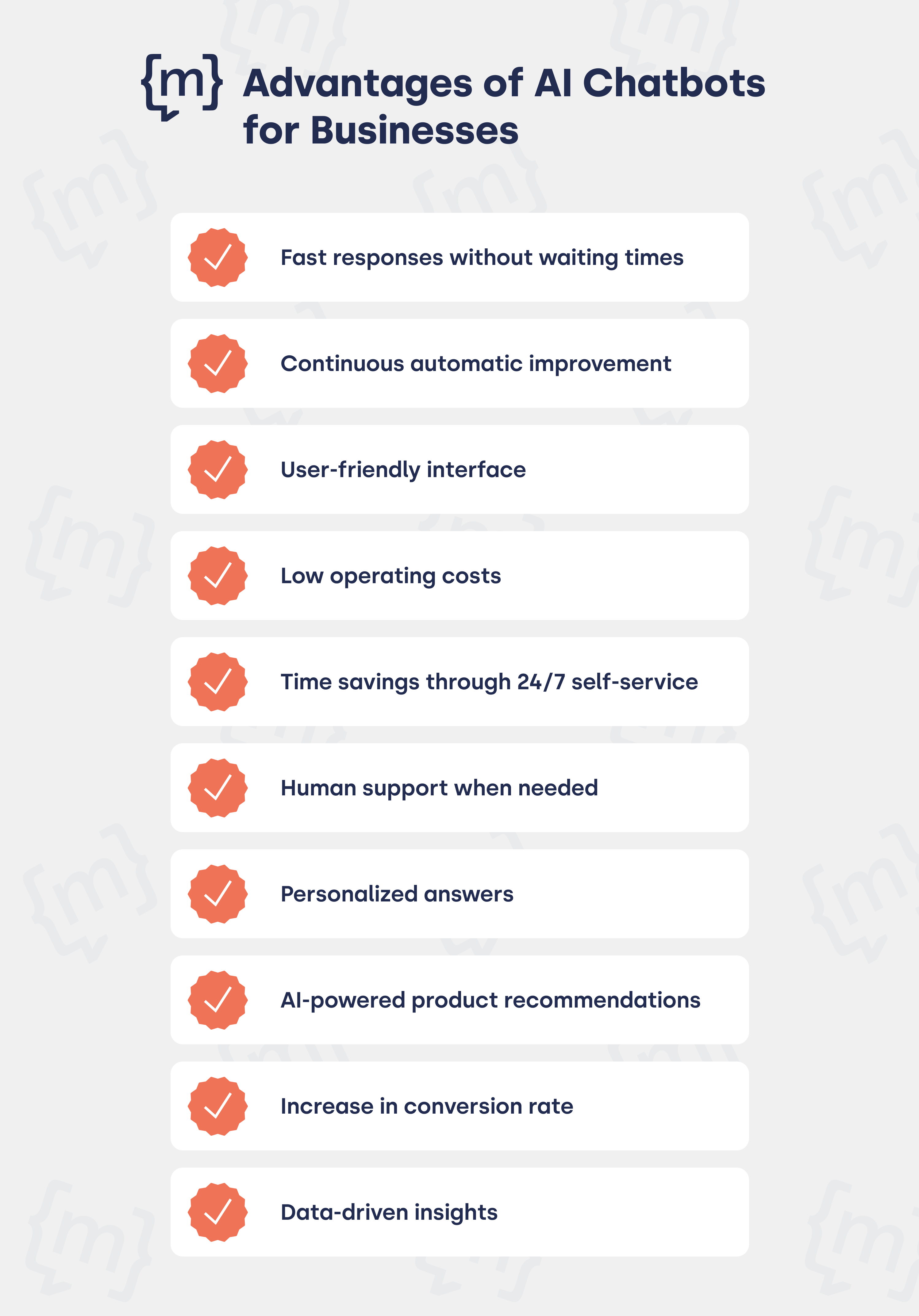
- Quick answers around the clock: Customers don’t have to sit on hold on the phone, click through FAQs or write an email and wait for a reply. With an AI chatbot, they can simply type in their question and receive a response in a matter of seconds.
- Adaptive and constantly improving: Once an AI chatbot has been initially trained, it continues to develop independently based on the conversations it has with users. As it evolves based on real conversations, it also grows in tandem with the actual wishes and needs of chatbot users.
- Easy to use despite complex technology: Technologically sophisticated behind the scenes, yet user-friendly on the front end: most AI chatbots offer intuitive interfaces – for both users and businesses, with no technical knowledge required.
- Minimal effort and costs that pay for themselves quickly: Once the AI chatbot has been set up and implemented, it doesn’t take much effort for companies to run it. As the AI continues to develop independently and the AI chatbot can handle thousands of enquiries simultaneously, the costs associated with an AI chatbot are quickly recouped.
→ Would you like to know how this translates into figures? Our ROI calculators show what an AI chatbot can save in marketing & sales or in customer service:
Return on investment of an AI chatbot in marketing and sales
Return on investment of an AI chatbot in customer service
- Self-service saves time for staff and customers: whether it’s changing a mobile number, downloading a certificate or clarifying a query – with an AI chatbot, users can resolve many issues themselves. This saves resources whilst also taking the pressure off internal teams.
- AI chatbot to human handover: There are issues that cannot be resolved by a chatbot but require human intervention; this is the case, for example, with highly complex issues or emotionally charged situations (more on this in the article: “Potentials & Limits: What Can a Chatbot Do? What Can't a Chatbot Do?”). Although communication via an AI chatbot is, in the traditional sense, a conversation between a human and a machine, this process can be interrupted at any time at the user’s request and handed over to a human. Users are never ‘trapped’ in a chatbot conversation. Thanks to what is known as ‘human takeover’, conversations can be handed over from the AI chatbot to a human agent via email or live chat. Nothing therefore stands in the way of ideal collaboration between humans and AI chatbots.
- Accurate and context-aware responses: Thanks to GenAI and linked data sources, many modern chatbots not only respond quickly but also in a personalised manner – they understand the context and provide relevant, accurate answers.
- Personalised product recommendations: Instead of having to wade through options, users are guided directly to the right product. AI chatbots analyse needs, ask follow-up questions and suggest suitable solutions – this increases the conversion rate and reduces decision fatigue.
What Areas of Application Are AI Chatbots Suitable for?
The main areas of application for AI chatbots are in corporate customer communication, primarily in marketing and sales, as well as in customer service. In both areas, they ensure that questions and enquiries are answered automatically and that users, prospective customers and existing customers receive accurate answers and efficient advice.
AI Chatbots in Customer Service
AI chatbots are traditionally best known in the field of customer service. There, they are often used as digital assistants to provide helpful support to website visitors, customers, partners or prospective clients. They usually answer simple, frequently asked questions. Around 80% of all incoming queries to customer service are of a recurring nature. This offers significant potential for automation, which AI chatbots are ideally suited to fulfil. The AI chatbot allows service staff to focus on complex issues.
Modern AI chatbots, such as those based on generative AI, also ensure that customer service responses are not only faster but also more precise and context-aware. Whilst traditional AI chatbots often only provide predefined answers, GenAI utilises the ability to respond to the user’s specific situation. This enables the chatbot not only to respond to common service enquiries such as delivery status, returns or warranty conditions, but also to dynamically handle more complex and less standardised enquiries.
Furthermore, the use of AI agents enables specialised tasks within the service process to be handled. For example, AI agents can process more complex support enquiries independently or forward them to the appropriate service representative. This ensures efficient handling of enquiries and improves the quality of customer service, as the chatbot intelligently supports the process and ensures that every enquiry is directed to the expertise required for that specific case.
A look at real-world examples – these companies are already using an AI chatbot in their customer service:
- Immoscout [Webinar]
- Neotaste [Webinar]
- Teleboy [Webinar]
- Blume2000 [Case-Study]
- Chocoversum [Case-Study]
AI Chatbots in Marketing and Sales
In the field of marketing and sales, AI chatbots can, for example, provide product advice and engage customers through temporary promotions, such as a quiz built into the chatbot. They automatically request contact details when there is interest in a product or service. They also make it easier to navigate the website, which is particularly valuable for large online stores or websites that need to host a lot of information.
AI chatbots in HR and personnel management
In addition to customer service, marketing and sales, AI chatbots can also be used in HR. There are various areas here where the use of a chatbot is beneficial, such as in recruitment, applicant and employee management, or for onboarding and offboarding, as well as the training and further development of staff.
In Which Sectors Are AI Chatbots Used?
As AI chatbots are highly versatile and adaptable, they are used in almost every sector. They can be deployed wherever questions need to be asked and answered. For example, the moinAI AI chatbot is used by over 100 companies across a wide range of industries. Find out below which industries are the most popular for AI chatbots and what benefits AI chatbots bring to these specific sectors:
.avif)
AI Chatbots in E-Commerce
- Converting website visitors into paying customers
- Helping customers navigate the shop more easily – e.g. through AI-based product recommendations
- Boosting customer satisfaction by providing assistance in seconds
- Scalable services – even during seasonal peaks or periods of growth
AI Chatbots in Finance
- Maintaining high standards of customer service
- Offering first-class service – at very favourable terms
- Standing out from competitors through service quality
- Real-time support that helps customers at any time
- Scalability: AI chatbots can handle large volumes of enquiries simultaneously, which is particularly important with a growing customer base or during peak periods
AI Chatbot in Tourism
- Provide global, round-the-clock service
- Dynamic multilingualism that can switch depending on the language used
- Automatically display up-to-date information (e.g. weather updates)
- Omni-channels: An AI chatbot can be used simultaneously on Facebook Messenger and on the website
AI Chatbots for the Energy Sector
- Provide simple self-service, e.g. for address changes
- Reduce the workload on support staff
- Automated, rapid responses to standard queries, such as instalment payments
- Give staff more time to focus on complex issues and concerns
AI Chatbots for Educational Institutions
- Stand out from other institutions through a modern and innovative communication channel
- Multilingual point of contact for international students
- Accessible contact option for students and prospective students
- Generate more applications automatically
AI Chatbots in Industry
- One channel for all target groups: whether B2B, B2C or B2B2C – the chatbot has answers for everyone
- Generate leads using forms built into the chatbot
- Pre-qualification of contacts: A chatbot guides users and pre-qualifies them
- Automate recurring questions from end customers
AI Chatbots in Publishing
- Prevent paywall abandonment: Convert visitors into paying customers
- Improve the subscription shop service: An AI chatbot takes over customer advice
- Efficiently automate recurring questions
- The editorial design of the chatbot is always in the hands of the company
Conclusion
AI chatbots are a key component of digital communication and automation, both today and in the future. They act as highly intelligent, personalised assistants that can not only answer simple questions but also handle complex interactions and advisory processes. Thanks in particular to technologies such as conversational AI and generative AI, they enhance the user experience and boost efficiency in customer service. The integration of emotional intelligence and data-driven insight generation makes chatbots indispensable tools for businesses.
Is your curiosity still piqued and would you like to see what a chatbot might look like in practice? Create an AI chatbot prototype tailored to your use case in four steps – completely free of charge and with no obligation.
[[CTA headline="Create a chatbot prototype now" subline="Our AI demonstrates what can be achieved through automation."]]


