

By 2026, the focus on chatbots in Europe will shift significantly: success will no longer be determined by technological feasibility alone, but above all by trust and the depth of integration.
The global market size for conversational AI was estimated at US$14.79 billion in 2025 and is projected to reach US$17.97 billion by 2026. (Fortune Business Insights, 2026) Regulatory frameworks such as the EU AI Act and increasing compliance requirements are becoming key decision-making factors. At the same time, ethical guidelines and the responsible use of AI are gaining in importance – particularly in sensitive areas of application.
Chatbots are increasingly being used internally as digital assistants and integrated into hybrid service models in which AI and humans work together in a targeted manner. Stand-alone Q&A chatbots without system integration, as well as generative solutions, are being replaced by fully integrated, multimodal solutions. We summarise the key trends for 2026:
1. From response systems to AI agents
AI agents have already established themselves as one of the key trends for 2026. Chatbots are gaining autonomy and greater scope for action through specialised agents: they access connected systems and combine information from various sources to deliver relevant results in real time. Agents take on expert roles for specific topics or processes and act independently, leading to faster and more efficient solutions. This not only saves time but also helps companies optimise their customer service around the clock, allowing human teams to focus more on complex and value-adding activities.
Two concrete examples of agent-based action:
- Availability check: An agent checks for available seminar places in real time based on current data and provides a reliable answer immediately.
- Product search in e-commerce: An agent filters products via the shop API according to user criteria and provides suitable results directly in the chat.
What exactly is the difference between AI agents and chatbots? ← Find the answer here.
Guided selling as a use case for agent-based systems
Particularly in the context of an omnichannel strategy, the integration of chatbots into the existing corporate infrastructure ensures a consistent user experience across various touchpoints – whether website, social media or customer portal. Guided selling remains an important use case, but is increasingly understood and utilised as part of agent-based workflows.
AI agents can therefore also act as AI-powered product advisors and guide users through decision-making processes in a structured manner. Through targeted questions and tailored advice, they adapt the interaction to different customer types, e.g. price-conscious buyers versus premium customers. Furthermore, queries are answered in a context-sensitive and comprehensible manner.
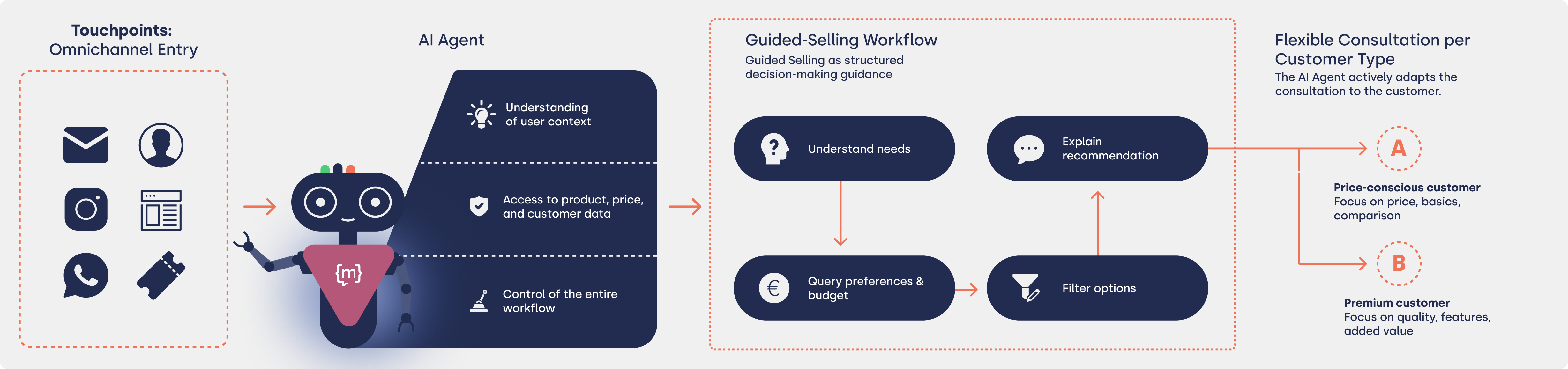
The added value lies not only in higher conversion rates, but also in better-informed purchasing decisions and a consistent standard of advice. Guided selling therefore enables businesses, particularly those in the e-commerce sector, to become increasingly user-friendly.
Further benefits of guided selling from the customer’s and the business’s perspective include:
Agentic AI as a game-changer
When it comes to the successful deployment of AI and chatbots, the focus is no longer on the quality of individual responses, but on the ability of chatbots to perform tasks reliably and seamlessly. Google, Microsoft and Salesforce, for example, have launched new models for fully autonomous workflows. The key factors for 2026 are:
- a clear division of roles between agents,
- governance and control mechanisms,
- deep system integration,
- and hybrid models that combine autonomy with human responsibility.
Despite growing autonomy, humans remain part of the system. If an agent cannot help or if human judgement is required, the handover takes place seamlessly within the same communication channel; this is also referred to as a ‘human takeover’.
2. Explainable AI as a key success factor
Explainable AI (XAI) refers to AI that builds trust among users by providing explanations. The AI explains in a clear and understandable way how and why a response is generated. In Germany and Europe in particular, Explainable AI (XAI) is becoming a key differentiating factor, strongly influenced by the GDPR and the EU AI Act. These regulations are increasing sensitivity to data protection and transparency, meaning that the sheer performance of chatbots is not always sufficient. Chatbots must provide clear references and decision-making logic, and highlight any uncertainties. The decisive competitive advantage arises where chatbots operate in an explainable and trustworthy manner. Companies that cannot offer transparency risk a loss of acceptance, regardless of their functional scope or degree of automation.
The first key provisions of the EU AI Act, including bans on manipulative AI applications, have been in force since 6 April 2026. While incomprehensible responses are one thing, far more serious are fabricated, misleading or false statements made on behalf of companies. You can read about the biggest chatbot fails here.
Domain-Specific Language Models (DSLMs) are a specific technological tool for improving explainability. Unlike large, universal language models, DSLMs specialise in a clearly defined subject area, such as German tax law or sector-specific product data. As they operate within a significantly smaller knowledge space, they are less prone to hallucinations and provide more comprehensible, verifiable answers. At the same time, DSLMs can often be run on-premises or in European data centres, which makes them particularly attractive from a data protection perspective.
3. Personalisation becomes responsible customisation
Personalisation remains a key feature of modern chatbots, but will be reimagined by 2026. Individuality and speed remain key expectations of AI chatbots. Conversational AI and generative AI enable more natural dialogues and flexible responses to complex queries. Younger customers in particular (Generation Z and Generation Y) expect and want fast, simple and personalised contact that delivers tangible added value. If a company cannot offer this service, customers are quick to switch to the competition, particularly in the areas of customer service and sales. Ultimately, the decisive competitive advantage is created by those chatbots that operate in a controllable and trustworthy manner. Companies must control how responses are delivered:
- rule-based,
- AI-supported with suggestions, or
- source-based.
and make this transparent to users.
Explainable GenAI approaches ensure that content is based on verified sources, responses remain consistent and verifiable, and hallucinations are actively limited. At the same time, chatbots are evolving into hyper-personalised assistants that can communicate not only in a purely factual manner, but also emotionally and empathetically depending on the situation. For example: the chatbot can respond reassuringly in the event of a complaint, whilst formulating motivating responses when a product is being purchased. Here too, it is important that no false expectations or manipulative effects are created and that transparency remains a priority.
4. Compliance and the legal framework (EU AI Act and GDPR)
As already mentioned, the important trend towards greater security and data protection is also affecting AI and chatbots. Consumers themselves, too, increasingly expect clarity and transparency, as well as the responsible handling of their data. Data protection and compliance are key design and selection criteria for AI systems. In this context, the EU AI Act plays a central role. The regulation is regarded as the world’s first legal framework for artificial intelligence and sets clear guidelines for the development, deployment and use of AI within the EU. Whilst the GDPR continues to govern the responsible handling of personal data, the EU AI Act broadens the focus to include risks, transparency obligations and human oversight of AI applications. The responsible use of AI is emphasised. The importance of this issue will increase even further in the coming years as data traffic and the number of transactions in the Internet of Things rise. Chatbots “Made in Germany” are the right choice for safeguarding data sovereignty and directly preventing any data protection issues. Furthermore, there must be a clear expectation that the provider is fully versed in data protection regulations and the GDPR-compliant use of the technology.
Closely linked to this is the concept of ‘geopatriation’: the targeted repatriation of corporate and customer data to local, European jurisdictions. Driven by the GDPR and the EU AI Act, major cloud providers are massively expanding their own capacities in Europe in order to offer businesses an infrastructure that is both legally compliant and high-performing. For the use of chatbots, this means that processing knowledge, conversation data and AI models within the EU strengthens the trust of customers and employees, who are increasingly prioritising data sovereignty.
Changing governance structures
In this context, governance means more than just legal compliance: it is essential to establish clear responsibilities and defined approval processes within the organisation. Furthermore, technical control mechanisms must ensure that AI systems operate within the intended parameters. These include, amongst others:
- Role and access management
- Audit logs
- Versioning of models and content
- Transparent escalation and shutdown mechanisms
Companies that comply with these regulations protect themselves legally, but above all gain the trust of users, employees and customers when they strategically use the regulations to their advantage.
5. Integrated knowledge bases for a reliable data foundation
Another trend is the now indispensable integration of structured knowledge bases into AI-powered chatbots. These enable the bot not only to answer simple FAQs, but also to provide complex corporate content in a structured, reliable manner, 24/7.
Ideally, the knowledge base is directly linked to the chatbot, meaning content does not need to be written manually. The AI automatically recognises relevant information, formats it for dialogue and generates appropriate responses from it. This ensures the chatbot remains up to date without every response needing to be maintained individually. This saves a huge amount of time and ensures consistent messaging across all channels.
RAG as the standard – trustworthy data as a differentiating factor
From a technical perspective, Retrieval-Augmented Generation (RAG) has established itself as the standard architecture. In this process, the AI generates answers based on specifically retrieved, verified content. It accesses reliable content from the database before generating a response, thereby ensuring accuracy even when dealing with complex or rare queries. You can find out more about RAG here: "Retrieval-Augmented Generation (RAG): The knowledge booster for LLMs”.
This is particularly helpful in the following areas of application:
- Technical support (e.g. error messages, step-by-step guides)
- Product information (e.g. dimensions, availability, materials)
- Internal knowledge sharing (e.g. for HR or onboarding)
- Documentation & support articles
Key to successful and correct integration: a multimodal knowledge base that can not only integrate text, but also images, videos and documents, or even generate them using GenAI. The trend goes beyond RAG alone and also encompasses ‘trustworthy data’. This includes clear source attribution and citability. Companies that rely on clean knowledge architectures and controlled data access lay the foundation for explainability and compliance, and thus for the sustainable use of AI.
6. APIs and MCP: Intelligent networking and integration of chatbots
The ability to integrate with business systems is becoming a key factor. These days, the ability of intelligent chatbots to communicate with other systems in the background is not merely a trend, but rather a fundamental necessity. The seamless integration of a chatbot into the operational systems and workflows of the existing IT and process landscape is a key prerequisite for its effective and productive use. If, for example, a customer asks in the chat about a credit note for a return, the dialogue system can coordinate directly with complaints and dispatch tools via interfaces (APIs). During the customer interaction, the chatbot gains real-time access to the logistics database, for instance.
As an integrated application, the chatbot brings together information, systems and processes in a central point of use.
The use of MCP servers is a prime example of this integration: they link chatbots to central enterprise systems and ensure that information is transmitted in real time and consistently. The MCP (Model Context Protocol) servers act as intermediaries between AI applications, such as chatbots or intelligent agents, and backend systems such as CRM, ERP or knowledge databases. Via the MCP server, natural language inputs are translated into technical queries, enabling access to relevant corporate data without the need for in-depth IT knowledge. This allows processes to be efficiently automated and customer communication to be improved through context-rich, precise responses.
→ You can find out more about MCP servers and their function in our glossary article "MCP Server - The New Interface Between AI and Enterprise Systems".
7. Voice AI / Voicebots for customer communication
Voice agents, also known as AI voice agents, are AI-based systems that understand spoken language in real time. By 2026, voicebots – i.e. support and service provided via voice automation – will be increasingly offered. This trend is linked to rising service expectations and high call volumes in customer service. Voicebots complement the use of multilingual and cross-channel chatbots, creating a decisive competitive advantage. They offer customers genuine, context-aware conversations. However, a seamless handover to a human agent is crucial for acceptance should an enquiry exceed the capabilities of the voice agent.
8. Predictive Intent Routing
Predictive Intent Routing complements traditional analytics and automatically and intelligently directs customers to the appropriate service channel or staff member.
This is based on large language models combined with historical conversation data and individual interaction patterns. This information is used to assess the likelihood of the customer’s next need and to determine whether the enquiry
- should be resolved automatically,
- forwarded to a specialised bot or a service channel,
- or handed over to a human agent.
In a business context, predictive routing forms part of the agent orchestration logic; it is not a standalone feature. By automating and streamlining processes, organisations can boost their productivity and proactively optimise service processes. Predictive intent routing enables more efficient utilisation of service teams and the orchestration of AI agents throughout the entire customer journey.
9. Forward-thinking chatbots: Generating insights
The strength of chatbots lies not only in direct customer communication, but also in their ability to provide valuable insights and thus map customer behaviour. By 2026, chatbot analytics will be more powerful than ever and, with the help of large language models, will be able to perform sentiment analysis and automatic topic clustering. Up-to-date information is derived from the total volume of incoming customer service enquiries, with anomalies being proactively flagged. Examples of potential insights from conversations:
- If an above-average number of consumers enquire about a product that is not in your range, you should analyse the demand further.
- If a customer reports login issues, this must be investigated. Is there a technical issue affecting multiple users?
- Does a user enquire about a specific way of using a product that your company has never considered? The specialist department may be able to derive product innovations from this.
- What is the tone of the customers’ messages, and what can be deduced from this about the target audience? This can reveal new terms or synonyms that the marketing team can use when creating content.
Practical example from customer service
In southern Germany, severe hailstorms had caused significant damage. A day later, a motor insurer (AdmiralDirekt, a moinAI client) received a large number of enquiries regarding weather-related damage. In this case, the chatbot can ask about hail damage as early as the welcome message, thereby ensuring even faster processing of the claim.
In the field of trend research, chatbot insights boost not only productivity but also customer satisfaction. However, it is and remains essential in this context that the generated data is reviewed and analysed by humans. Furthermore, the data collected must always be processed in compliance with data protection regulations (e.g. the GDPR).
10. Ethics and sustainability of AI systems
By 2026, ethics and sustainability will be considered integral components of any responsible AI strategy. In Europe, the Ethics Guidelines for Trustworthy AI and the EU AI Act require stakeholders to design their AI systems in a fair and human-centred manner. The aim is to build trust and gain societal acceptance, particularly for AI applications that involve direct user contact, such as chatbots. The concept of ‘geopatriation’ describes the trend of repatriating data to local, European jurisdictions. Cloud providers are currently building up massive capacities in Europe for this purpose. At the same time, organisational accountability must also come to the fore. Companies must establish appropriate governance structures that operationalise ethical principles – in other words, define clear responsibilities, carry out impact assessments, and implement documentation and continuous monitoring.
Another key aspect lies in the environmental sustainability of AI. Training and operating large models is very energy- and resource-intensive. Concepts such as ‘Sustainable AI’ seek to critically examine efficiency, scale and use cases in order to reduce environmental impact and enable AI to be operated responsibly in the long term.
Conclusion: Growing acceptance and further development
The trends in chatbots clearly show that the future belongs to agent-based, multimodal AI systems that resolve queries autonomously in an integrated and explainable manner, delivering demonstrable added value.
Key success factors include deep integration into business processes, trustworthy data architectures, Explainable AI, and governance and compliance models that are in line with the GDPR and the EU AI Act. The focus is shifting from pure personalisation towards responsible individualisation, where transparency, control and traceability are paramount.
At the same time, the playing field itself is changing: products and purchasing decisions are increasingly being researched directly via generic AI chatbots such as ChatGPT or Gemini. A company’s own chatbot must no longer simply impress internally, but must also remain relevant and discoverable when compared to general AI assistants – for example, through structured, clearly citable content and a close link to the company’s own knowledge base. Thanks to easier and more affordable access to these applications and systems, an increasing number of small and medium-sized enterprises are also turning to AI chatbots, particularly in customer service. Through AI integration, companies are able to manage and process the many points of contact with customers via a central communication channel and analyse the data for insights. For businesses, the following applies: those that take a holistic view of chatbots – i.e. from a technological, organisational and regulatory perspective – lay the foundations for long-term productivity and high customer satisfaction.
Would you like to leverage the latest chatbot trends in service, marketing and sales for your business? Then try out our AI chatbot for your specific use case and see for yourself.
[[CTA headline="Use an AI chatbot in your company in 2026!" subline="It’s high time to automate customer communication. Choose GDPR-compliant and innovative AI features with moinAI." placeholder="Insert your company URL here" button="Try it now!"]]


.svg)


