
What is the Universal Commerce Protocol?
UCP stands for "Universal Commerce Protocol" and was initiated by Google and introduced in early 2026 as a new, open standard for "agentic commerce", i.e. commerce using AI. It establishes common rules for agent-based interaction with product catalogues, shopping baskets and payments, eliminating the need for individual integrations for each individual retailer. The protocol thus enables compatibility across a standard, whereby the steps of the customer journey can be transferred to AI agents in a machine-readable format.
Benefits and context of origin
The aim of the Universal Commerce Protocol (UCP) is to facilitate communication and interoperability between different commercial enterprises. UCP was developed "by the industry for the industry" (UCP, 2026), with key partners including Shopify, Etsy and Walmart. The focus of development is on providing a technically comprehensive and structural basis for simplifying and standardising communication between AI agents and websites, enabling users to complete purchases without leaving the AI chat or search interface. This resolves fragmented purchasing processes that can lead to abandoned shopping baskets and frustrated buyers. Until now, shop systems and payment services have spoken different languages, but UCP breaks down these platform silos.
How does UCP work technically?
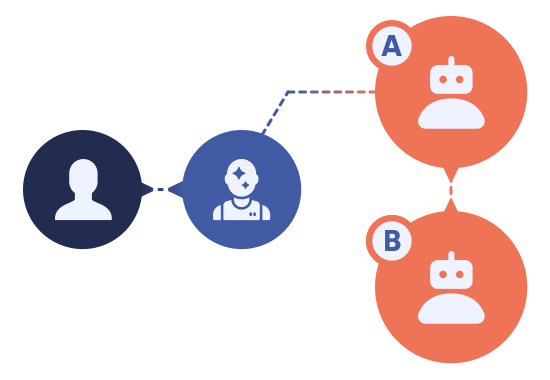
UCP standardises the actual trading process and defines a series of standard functions: offer, identity and payment. All UCP communication must take place via HTTPS, the basic prerequisite for trustworthy, secure communication on the network. The UCP development page also shows that further capabilities are already in development. Here is a simplified diagram of the high-level architecture:

The UCP framework is based on three core principles that structure the interaction between stakeholders and determine the architecture:
- The foundation is formed by capabilities, which define the actual business functions or activities such as placing orders, checkout, etc.
- These are supplemented by extensions, which are optional additions that integrate specific additional functions such as discounts or regulatory requirements (e.g. mandates) directly into the existing core processes.
- UCP is implemented technically via services. These form the communication layer (e.g. REST APIs or agent-to-agent protocols) and ensure that data can be exchanged interoperably regardless of the chosen transmission path.
UCP distinguishes between four different actors with defined roles in the trading lifecycle:
1. Platform (Application/Agent): Controls the commerce journey, acts as an interface to the customer
Main task: Discovering companies and executing user requests
Responsibilities: Retrieving company profiles, initiating checkout and providing the user interface (UI/chat)
Examples: AI shopping assistants, search engines.
2. Business: The actual seller of goods or services.
Main task: As merchant of record (MoR), bears financial liability and owns the order.
Responsibilities: Providing availability and prices, order and payment processing.
Examples: Retailers, airlines, hotels.
3. Credential provider (CP): Management of sensitive data as a trusted authority
Main task: Secure storage and release of payment data and identity information
Responsibilities: Authentication of the user, issuance of payment tokens (to protect raw data) and reduction of compliance efforts for other players
Examples: Digital wallets (Apple Pay, Google Wallet), identity providers.
4. Payment Service Provider (PSP): The financial infrastructure in the background
Main task: Processing transactions on behalf of the company
Responsibilities: Authorising and recording payments, billing and communicating with card networks; often interacts directly with the credential provider's tokens
Examples: Stripe, Adyen, PayPal
The exact technical implementation, with all conventions and governance aspects, can be viewed publicly via the Universal Commerce Protocol (UCP) Official Specification.
Use cases and advantages
UCP comes into play where there is an intention to purchase: checkout, identity and order processing are transactional phases that can be standardised and automated using UCP. The upstream phases of the commerce lifecycle, specifically awareness, interest and consideration, are not directly covered by UCP. Mechanisms such as SEO, paid advertising and recommendations from AI agents therefore remain relevant for drawing users' attention to a product. The three initial core capabilities of UCP at a glance:
- Checkout: Support for complex shopping cart logic, dynamic pricing, tax calculation and more via a unified checkout session.
- Identity linking: Via OAuth 2.0, AI agents and platforms can establish secure, authorised relationships with shops without sharing access data.
- Order management: Real-time webhooks enable status updates, shipment tracking and returns processing across all channels, from purchase confirmation to delivery.
In addition, there are two checkout modes: Native Checkout (direct API integration for platform-specific UI) and Embedded Checkout (embedding of the merchant UI with bidirectional communication). The valuable aspect of using UCP for businesses is that merchants retain their business rules and remain the merchant of record. This means that they have a direct relationship with the customer and retain control over data, customer service, offers, etc.
AI chatbots are a relevant example of the use of the UCP standard, as they often fail because, although they can interact with the user, they are not allowed to complete transactions (purchases or bookings) without redirecting the user to an external website. Thanks to UCP, however, the chatbot can now access product data, stock levels and payment systems in real time without having to integrate each interface individually. The user receives selected suggestions and can complete the purchase seamlessly within the chat without any media discontinuity.

Advantages of UCP
Particularly advantageous for companies are the reduced costs and high scalability of the application possibilities. Further advantages include:
- low integration costs
- shortened time-to-market
- high scalability
- easy integration of platforms or services without significant additional effort
- open-source standard allowing easy testing and customisation
- UCP support from global technology and retail leaders.
The partners and customers are a combination of tech giants, trading platforms and payment providers, sending a strong signal to the market. Platforms no longer need to be connected individually and at great expense, as UCP functions as a universal standard for the systems. UCP fully supports the technologies that AI agents need to communicate and act independently. The three central protocols are:
- MCP (Model Context Protocol) enables AI agents to access relevant merchant data in real time
- A2A (Agent2Agent) regulates structured communication and task sharing between different agents, and
- AP2 (Agent Payments Protocol) ensures that payments are triggered securely and automatically at the end of the process.
Together, they cover the entire agent-based purchasing process and create the technical basis for UCP to cover the entire purchasing process.
What are the challenges of UCP?
The biggest challenges with regard to AI in traditional e-commerce are technical and organisational: retailers must prepare their existing systems and product data so that they are machine-readable and UCP-compatible, while at the same time retailers and users must be able to trust that the agents are acting reliably and securely in the interests of all parties involved.
Technical requirements
Although UCP simplifies long-term integration, the initial setup requires a high level of internal change effort. The effort can be considerable, especially for smaller retailers without specialised IT resources. A dedicated IP infrastructure is expensive, and prepared real-time data feeds are necessary for the use of UCP. Unstructured product data complicates setup, and errors in security checks can cause AI agents to mark a requested shop as unavailable. This has a negative impact on the visibility of recommendations.
In addition, the technical challenge for legacy systems is that inventory and price data must be continuously updated so that AI agents communicate the correct availability. If an agent misinterprets an input prompt and an erroneous order is placed, liability issues arise. These concerns are also reflected in acceptance; fully autonomous shopping requires a high level of user trust.
Effect on the customer journey
One particular criticism of "zero-click commerce" is that, with the AI assistant as the primary brand interface, there is less direct traffic to retailer websites, which makes strategies such as retargeting and cross-selling more difficult. In addition, the customer experience with the retailer itself is fundamentally changed and customer loyalty becomes a challenge due to the reduced interaction. Criticism is therefore also directed at dependence on the Google ecosystem.
Visibility despite UCP: what retailers can do now
When using the Universal Commerce Protocol, it is important to take stock of the situation: are product data, prices and availability structured and prepared in such a way that AI agents can read them? A qualitative basis of clean, structured data is crucial for agent-based commerce.
Investments in proprietary channels, i.e. newsletters, apps and direct customer relationships, are gaining strategic importance, and UCP should be seen as a new opportunity to attract customers to products through simple purchase transactions.
Flexibility in the choice of protocol and integration helps to avoid exclusive commitment to a single standard. A multi-protocol strategy could include alternatives such as OpenAI and Stripe's Agentic Commerce Protocol (ACP), for example, so that retailers are not tied exclusively to one standard.
UCP should not be seen as a threat, but as a powerful channel that can simplify the customer journey and increase reach, provided that companies prepare themselves technically and strategically.
Conclusion: Where is UCP headed?
UCP as a standard is becoming increasingly intelligent, but it must address the challenges mentioned above in order to drive agentic commerce across industries and gain the trust of retailers and customers. Until now, users had to search, navigate and compare on their own. Now, users can simply ask an AI agent, AI chatbot or voice assistant. Seamless dialogue with customers and a personalised customer journey are key to successful trading via UCP. Traditional product detail pages are becoming less relevant. In the future, retailers will have to optimise content and services primarily for AI agents in order to remain competitive.
[[CTA headline="Use moinAI for seamless customer service across all channels" subline="The future of conversational business lies in agent-based communication: try it out with our AI chatbot directly on your site." button="Try it now" placeholder="Enter your website"]]