
What is an AI chatbot for local governments?
An AI chatbot for local government answers citizens' questions automatically and in natural language, even outside of office hours. Unlike ChatGPT, it does not search the open web. It formulates its answers exclusively from pre-approved sources. This ensures the local authority retains full control over content and responses. AI-generated answers are clearly marked in the chat, as required by the EU AI Act for generative AI stipulates.
Such a chatbot is particularly interesting for city and municipal administrations, district offices, public utilities, special-purpose associations, and waste management companies.
What are typical use cases for AI?
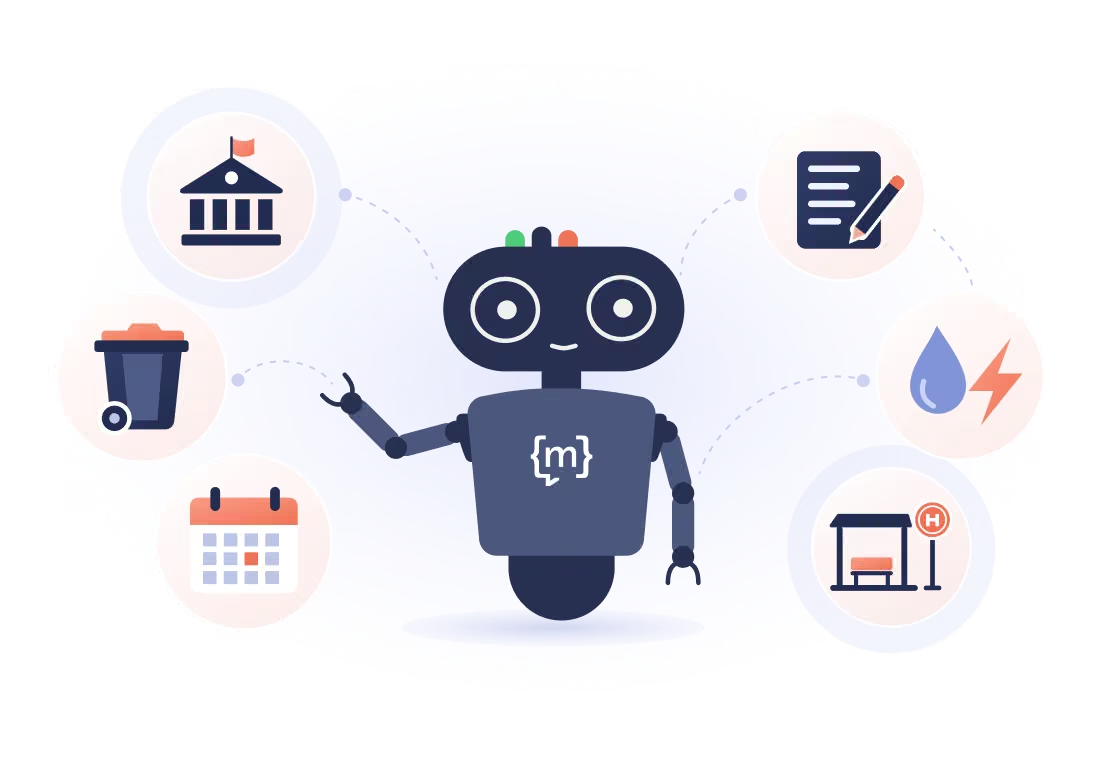
For local authorities, AI is ideal wherever many similar questions arise and the answers are already available in documents or specialized systems. Typical areas include citizen services, waste management, public utilities, and municipal facilities. A separate AI agent with dedicated sources and rules can be set up for each subject area. At AVR Kommunal, for example, each of the seven main topics is assigned its own AI agent.
How does an AI chatbot for local governments work?
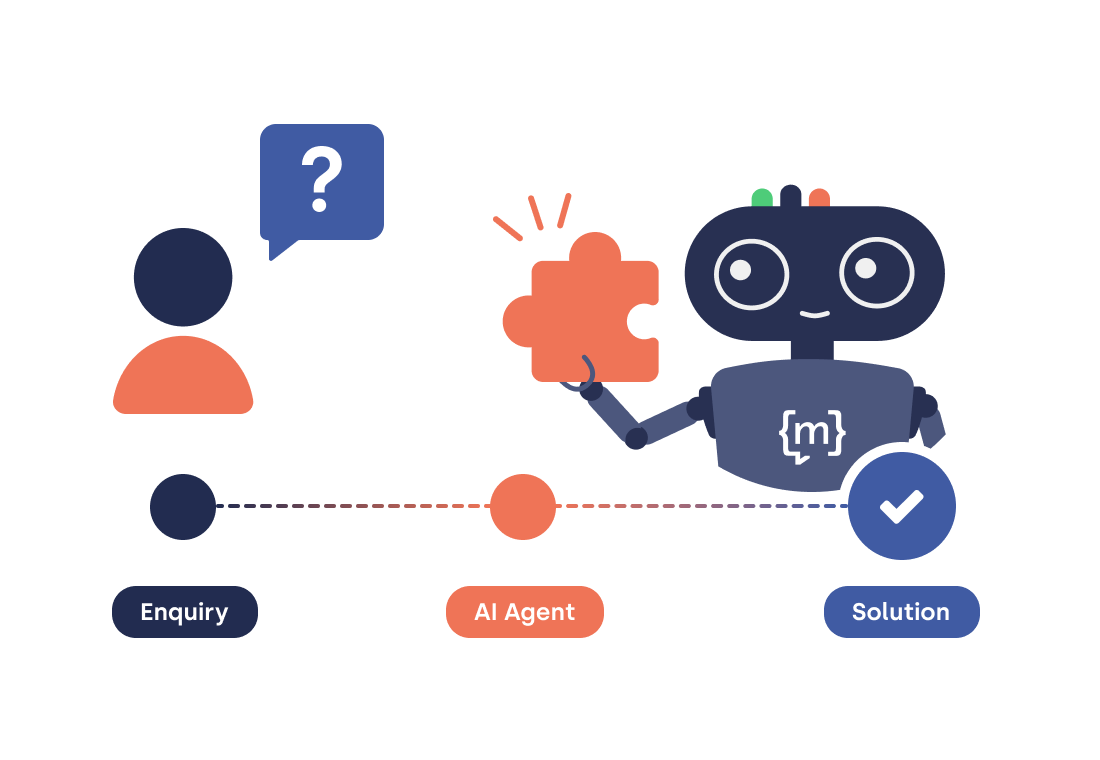
An AI chatbot for local government uses controllable generative AI. The AI formulates its own answers, but is only permitted to access approved content. In the background, every request follows a five-step process:
- Someone asks a question in the chat.
- The AI analyzes the request.
- It identifies the relevant subject area.
- The responsible AI agent takes over.
- The AI agent generates the answer from the knowledge base.
Knowledge bases, RAG, and knowledge gaps: What really matters
The knowledge base is the repository of information that all AI agents access. The local authority decides which sources to include: websites, documents, Q&A pairs, PDFs, or CSV files. There is no open web scraping.
Technically, this is powered by RAG (Retrieval-Augmented Generation). The AI first retrieves the relevant content and then formulates the answer. This verification of knowledge largely prevents hallucinations.
Knowledge gaps are revealed through user feedback, statistics in the moinAI Hub, and Dreaming. At the end of a conversation, the chatbot asks if the answer was helpful. Every conversation and rating can be viewed in the moinAI Hub.
Dreaming also automatically evaluates every conversation and shows which questions come up repeatedly and which topics are still missing from the knowledge base.
Standard agents and specialized agents explained
Standard agents answer knowledge-based questions from the knowledge base, while specialised agents execute fixed processes such as container changes, order intake, or complaints, while adhering to predefined rules.
Through interfaces, AI agents also access other company systems like SAP. This ensures data is maintained in only one place. Guardrails block attempts to manipulate incoming messages and keep outgoing responses within the specified framework and the municipality's tone of voice.
What distinguishes an AI agent from a classic chatbot?
A classic chatbot answers questions, explains how to do something, and sends you to the appropriate form. An AI agent, on the other hand, handles the task itself because it can access connected systems and take action via AI actions.
Taking the example of bulky waste illustrates the difference well: If you type "I want to register bulky waste" into a classic chatbot, you get a link to an online form. An AI agent with access to the order system accepts the registration directly in the chat and creates the order. This is exactly what defines Agentic AI: resolving requests independently and definitively through deep integration, rather than just answering them.
Practical example: The AI chatbot AnTonn from AVR Kommunal
AVR Kommunal AöR is the waste management authority for 54 cities and municipalities in the Rhein-Neckar district. Since October 2025, it has been answering citizens' questions using AnTonn, an AI chatbot based on moinAI. From January to June 2026, AnTonn processed 27,060 requests and answered an average of 95% of them automatically. Seven AI agents share the workload across different topics.
For this use case, the approved sources are the company's own website, the waste management statutes, PDF documents, and internal knowledge databases. Below the answers in the chat window, the "AnTonn" chatbot displays which sources were used to generate the response. In the background, every answer can be traced back to its origin.
Results
In May 2026, AnTonn conducted 4,404 conversations with an automation rate of 96%. The most frequent topics were waste consulting (1,122 views), order intake (802), and the waste calendar (674).
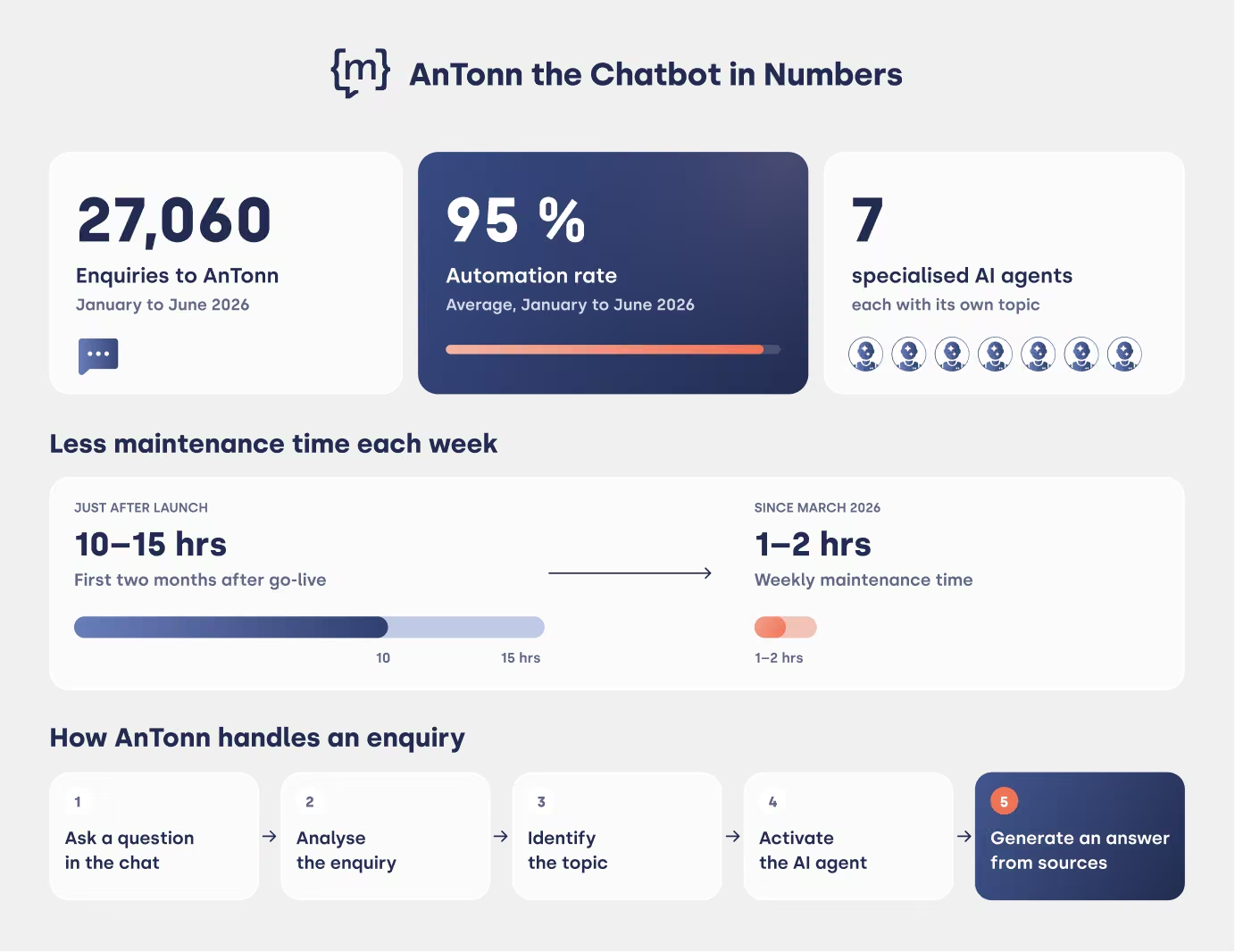
AnTonn does not replace AVR employees. It takes over routine tasks, leaving more time for individual consultation and complex issues. Since March 2026, AnTonn has required only 1–2 hours of maintenance per week. In the beginning, time is primarily needed for analyzing requests and fine-tuning individual AI agents.
Why AVR chose moinAI
A primary goal for AVR was to achieve high levels of automation while maintaining control over the content. After presentations and live demos from various providers, they chose moinAI, partly due to the solution's core features:
- GDPR-compliant platform from Germany
- Easy maintenance of the knowledge base
- Extensive statistics and analysis options
- Integration of existing systems
- No cost per inquiry
How can municipalities get started with Agentic AI?
Municipalities should start with an internal analysis rather than the technology. This is how AVR Kommunal introduced its chatbot.
- Collect frequently asked questions. Before your first meeting with a provider, clarify which questions are asked most often, which processes can be automated, and where the risks lie.
- Test from the citizens' perspective. Employees often ask much more complex questions than citizens do. Therefore, make sure to have people without specialized knowledge test it as well.
- Start small. For the go-live, AVR deliberately avoided a large-scale campaign and instead improved the chatbot based on real inquiries.
- Name and tone last. Only once the content is right is it worth working on the name, avatar, and tone of voice. The name should not give the impression that a human is responding.
What should municipalities look for when choosing an AI chatbot?
The most important factors are control over sources, data protection, and integration with your own specialized systems. If you define in advance which questions and processes the chatbot should cover, you can compare providers more effectively.
- Sources: Ask for a demo to see where an answer comes from and how to add or remove sources.
- Data protection: Clarify where the solution is developed and hosted, and involve your data protection officer early on.
- Specialized systems: List the systems where your data resides, such as SAP, and ask about existing interfaces.
- Operational capability: Test a real process, such as a bulky waste collection request or an appointment booking, rather than just FAQs.
- Evaluation: Ask to see the dashboard, including topics, feedback, and automation rates.
- Accessibility: Check whether the chat widget complies with WCAG 2.1 (BFSG).
- Costs: Compare fixed pricing with per-request billing. With per-request billing, costs increase as the chatbot is used more.
Conclusion: Agentic AI is worth it for municipalities
For municipalities, agentic AI solves a very common problem: recurring questions are answered for citizens regardless of service hours. An AI chatbot that only answers from verified sources takes this routine work off the service team's hands without the municipality losing control over its content.
When AI agents are connected to specialized systems, they can resolve requests directly in the chat, saving citizens the detour of filling out forms. You can see what this looks like for your own use case at moin.ai/start and try it out with your own AI agent.