


What is the Code of Practice on transparency of AI-generated content?
The Artificial Intelligence Regulation (AI Regulation) is better known as the EU AI Act. This is the European Union regulation on the labelling of AI-generated content. The EU regulation is generally due to come into force in August 2024, with the transparency requirements taking full effect from 2 August 2026. The new regulation aims to clearly signal to users, when interacting with artificial intelligence, that they are dealing with an AI system and AI-generated content.
Article 50 of the AI Regulation: What the law says
Article 50 sets out the specific transparency obligations for providers and operators of AI systems. It is therefore the key article for companies that use AI-based communication solutions. The following changes will apply from August 2026
- AI interactions must be identifiable: It must be made clear and understandable that communication is taking place with an AI system, at the latest upon first contact.
- AI-generated content must be labelled: Content such as text, images, videos and audio that has been created predominantly by AI must be marked as such.
- Deepfakes must be clearly identified: Deceptively realistic, AI-generated or AI-manipulated media content must be labelled in such a way that it is clearly recognisable as inauthentic.
By the way: the terms ‘AI slop’ and ‘deepfakes’ both refer to content generated by artificial intelligence. You can find out exactly what AI slop is in the article ‘AI Slop: Content Flood in the AI Age".
AI labelling requirement: Who is affected – providers or operators?
The Regulation makes a fundamental distinction between two groups of addressees: the provider and the operator:
- Providers (Article 3(3) of the AI Regulation) are companies or individuals who develop an AI system or commission its development:
- for example, the creators of large language models (OpenAI, Google) or developers of proprietary AI technologies.
- Obligations include risk management systems, technical documentation and transparency requirements.
- Operators (Art. 3(4) of the AI Regulation) are any natural or legal persons who use an AI system in the course of their professional activities:
- e.g. a company that integrates a chatbot on its website for customer communication.
- Obligations include complying with the provider’s instructions for use, monitoring the system’s input and output data, and protecting the AI from misuse.
The Federal Network Agency Germany provides a detailed overview of the transparency obligations of providers and operators in the form of a comparative table.
For most companies, the focus is therefore clearly on the operator’s perspective, and this also applies to customers who use moinAI solutions. The key point is this: anyone who operates an AI chatbot on their own platform and uses it to interact with customers is responsible for ensuring that it is labelled in accordance with the regulations for users.
When does the labelling requirement apply, and when does it not?
The requirement to label AI content applies as soon as an AI system plays a significant role in creating and publishing content; however, it does not apply if the content has previously been reviewed or edited by a human. This is because, in such cases, there was an opportunity to amend or reject the AI-generated content, so labelling is not necessary. We use examples to illustrate what applies in each situation.
Labelling requirement: primarily AI-generated content
Wherever an AI system generates the content to a significant extent and there is insufficient human oversight, this must be clearly indicated. Specifically, this applies to two scenarios:
- Chatbots and virtual assistants: Labelling will be required for any AI system that interacts directly with humans. The wording could, for example, read: ‘You are currently communicating with an AI system.’ This information must not be hidden in the small print.
- AI-generated texts on public matters: AI-generated texts concerning matters of public interest must disclose their artificial origin. This applies, for example, to press releases or informative blog posts. A visible label at the beginning of the text is sufficient, for example: “This text was created in whole or in part using AI.”
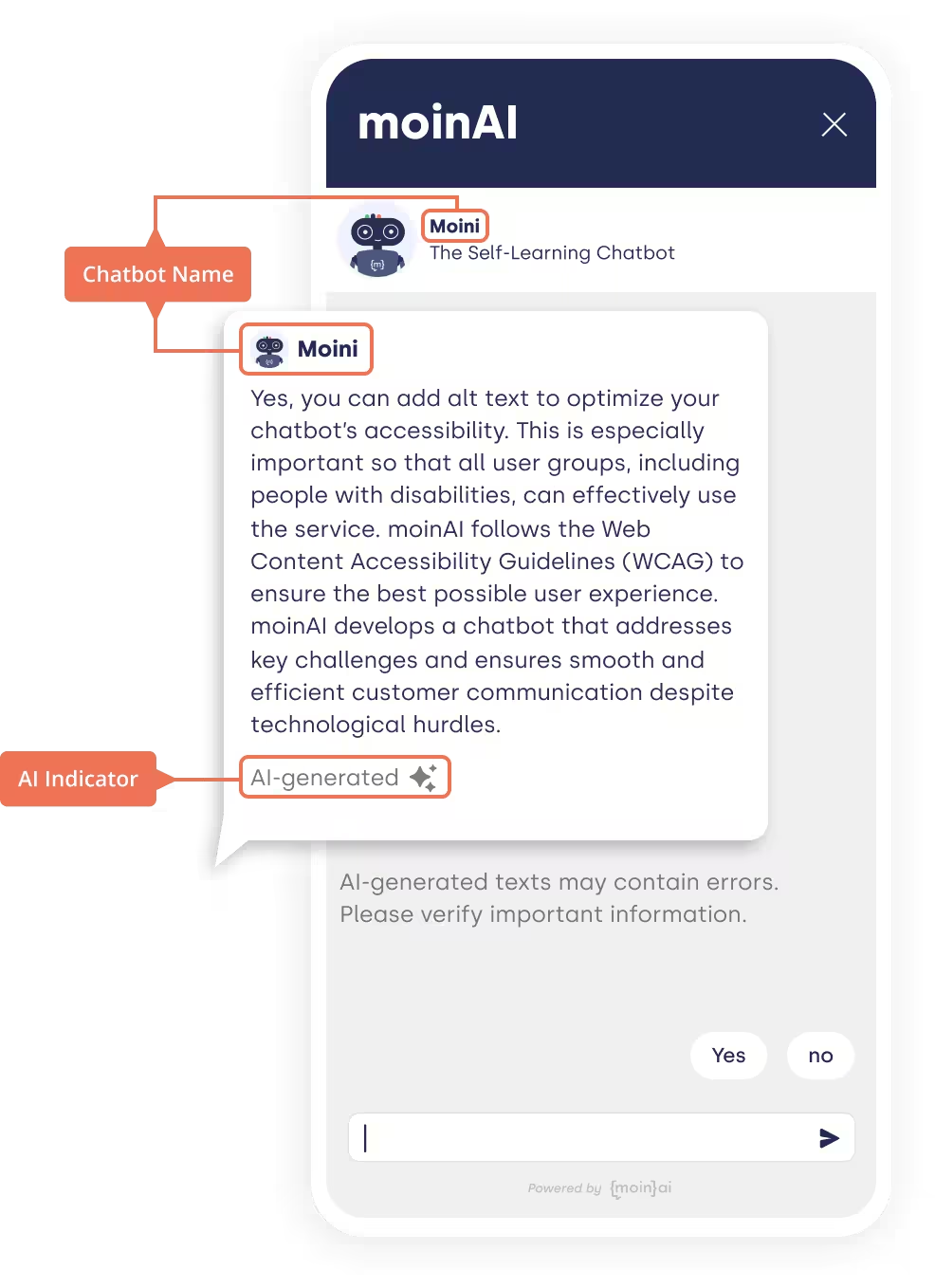
Example AI chatbot: The label ‘AI-generated’ or some other form of AI labelling must be clearly visible if a company operates an AI chatbot on its website where responses are based solely on AI. For companies using moinAI, this means that if agents are used to formulate and send replies using generative AI, a reference to generative AI is essential. The good news is that moinAI automatically includes this reference.
When people are in control
When the labelling requirement for AI-generated texts ceases to apply, and under what conditions, as set out in Article 50(4), second subparagraph, of the AI Regulation:
- There must be a human review or editorial check before publication: not a spell-check or formatting check, but a comprehensive review of the content to ensure its accuracy, plausibility and the reliability of its sources.
- Content may therefore be amended or rejected. A clearly identifiable natural or legal person assumes editorial responsibility for the content. It must be clearly documented who specifically bears this responsibility.
Example of AI text generators in marketing: Drafts of blog articles created using an AI text generator are subsequently reviewed and edited by the editorial team. In this case, there is no obligation to label the content, as the human review is clearly documented and verifiable.
Exceptions and special cases regarding the AI labelling requirement
In addition to the exception for human-moderated content, the AI Regulation provides for further special cases that are relevant in practice:
- Obvious recognisability: If it is already clear to a reasonably well-informed person that they are interacting with AI, there is no explicit obligation to label it; this would apply, for example, to a robot with a clearly synthetic voice.
- Law enforcement and covert investigations: AI systems used as part of legally authorised measures to detect, prevent, investigate or prosecute criminal offences are exempt from the disclosure requirement.
- Simplified obligations for SME: SME and freelancers benefit from simplified documentation and reporting requirements under the AI Regulation, though not in relation to the core obligations set out in Article 50. The labelling requirement is equally binding for SMEs.
- Artistic and satirical works: For works that are clearly fictional, creative, satirical or similar, the labelling must be designed in such a way that it does not impair the presentation or artistic enjoyment. This exception allows for a less intrusive form of labelling.
Here the most important rules for when to add an AI label at a glance:
.avif)
What does this change mean for chatbot operators?
The AI Regulation does not prescribe any specific form of labelling, but does require “clear and unambiguous information” to be provided at the point of contact with the AI. Examples of such wording could therefore be as follows:
- A visible message in the chat window: “You are currently communicating with an AI system.” / “This content was generated by AI.”
- A welcome message from the chatbot that directly states its AI nature.
What measures do companies need to take?
Companies must clearly coordinate the use of AI internally; this includes, in particular, the following measures:
- Regulating the use of AI: Who is permitted to use which AI tools, and for what purposes? This actively prevents the uncontrolled use of AI, often referred to in practice as ‘shadow AI’.
- Defining responsibilities: Who reviews AI-generated content before publication? It is helpful here to appoint an AI officer to establish clear lines of responsibility.
- Documenting AI use: The more comprehensively AI use is documented within the organisation, the better – for internal oversight, but above all for regulatory inspections
What penalties apply for breaches?
Anyone who breaches the AI labelling requirement faces fines. Under Article 99 of the AI Regulation, penalties of up to €15 million or 3% of global annual turnover may be imposed, whichever is higher. Added to this is a loss of trust among customers and partners, which can have a negative long-term impact on a company’s success. Early compliance protects against potential penalties and reputational damage!
Mandatory AI labelling and moinAI
In moinAI, the labelling for AI-generated content is enabled by default. If required, the appearance and wording of the label can be customised at any time in the Hub.
- Ole Meistering, Product Manager at moinAI
The technical requirements for complying with the AI labelling obligation are already built into the moinAI solutions, without the need for any technical adjustments.
The built-in AI indicator in moinAI shows users directly within the chat widget as soon as a response has been generated by generative AI. The label appears automatically beneath every GenAI-generated response, in context and without interrupting the flow of the conversation.
Specific recommendations for moinAI operators, as defined by the AI Regulation, include:
- Customising the chatbot’s welcome message: This is an opportunity to make an unambiguous reference to the AI nature of the interaction.
- Choosing a distinctive name and persona for the chatbot: To prevent misunderstandings from the outset, it is worth either explicitly referring to the chatbot as a digital assistant or giving it a friendly mascot-style persona. The name should be chosen in such a way that it is immediately clear that it is not a human being – you can also find valuable tips on this in our article"Finding the right chatbot name"
To find out what exactly the benefits of AI chatbots on a website are, and what advantages the widget offers businesses, read the following article: Chatbots on the website.
Conclusion: Transparency by Design with moinAI
Under the EU AI Regulation, the labelling of AI chatbots is a legal requirement; moinAI already includes this as standard: the requirements are already embedded as native default settings within the platform. The moinAI solution comes with the necessary technical setup for legally compliant use, is 100% GDPR-compliant, is hosted in Germany and fully complies with the requirements of the EU AI Act. This ensures data protection-compliant transparency with minimal configuration effort.
Are you ready to use AI to optimise your company’s customer service in a transparent way? Then try it out right here with your URL.
[[CTA headline="Your AI chatbot. Transparent. Compliant." subline="Discover how moinAI implements AI labelling requirements in AI solutions automatically, easily and without the need for IT support." placeholder="Insert your company URL here" button="Try it now!"]]


