
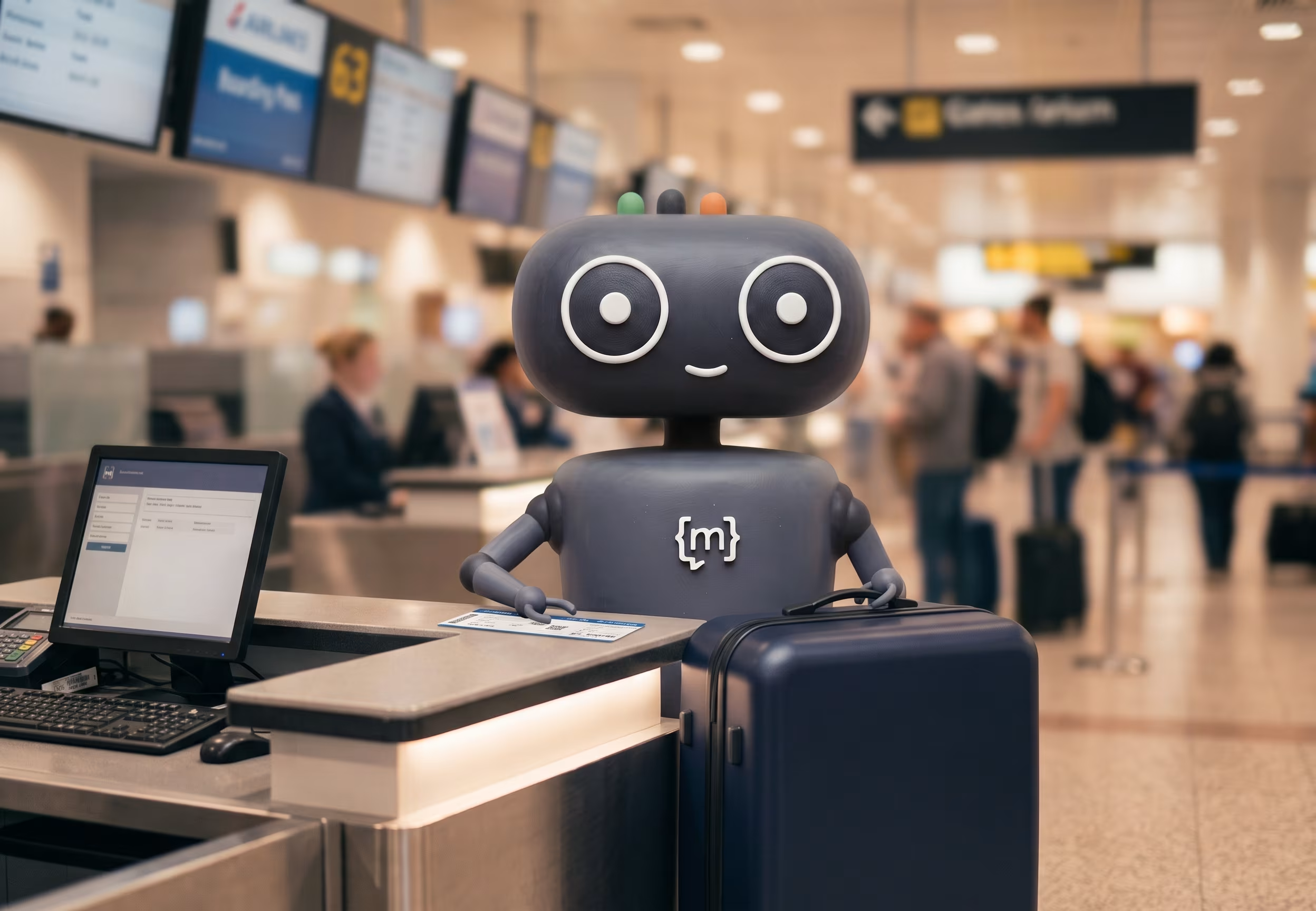

Anyone who has ever found themselves nervously stuck on hold just before going on holiday will know the feeling: you just want an answer to a simple question. Airports are among the organisations that deal with the widest and, at the same time, most consistent range of queries of all.
We present 20 typical passenger enquiries from everyday airport life, sorted into four categories, and answer them straight away, just as a chatbot would.
Category 1: Getting there and parking
1. What parking facilities are available at the airport, and how far are they from the terminal?
2. Are the car parks open 24 hours a day?
3. Can you book parking spaces online in advance?
4. Where can I drop someone off or pick them up briefly without having to park?
5. What are the public transport links to the airport at night?
Category 2: Check-in and Luggage
6. How long before departure should I arrive at the airport?
7. When does the check-in desk for my flight open?
8. Can I still check in luggage even if I’ve checked in online?
9. Are power banks allowed in hand luggage?
10. Is there a luggage storage facility at the airport?
Wanna try it yourself?
The proof is in the pudding! Below you’ll find a demo bot, which has been trained using information from a sample scenario (Moinis Airport). The Moinis Airport bot demonstrates just how quickly and easily questions about the travel hubs can be answered:
Category 3: Security checks and departure
11. How long does the security check take?
12. How much liquid can I take through security?
13. What do I need to remove from my hand luggage at the security check?
14. Where can I find my departure gate?
15. What should I do if I’m in danger of missing my connecting flight?
Category 4: Arrival and on-site services
16. Where is the baggage reclaim area for my flight after landing?
17. Is there free Wi-Fi at the airport?
18. My checked-in luggage is damaged/lost, what should I do now?
19. Where can I still get something to eat or do some shopping at the airport?
20. Where can I get the latest information about my flight?

Live information via chatbot: How airports can leverage AI
What do all these questions have in common? They are predictable, clearly definable and, in the vast majority of cases, can be resolved with a structured response. These are precisely the conditions under which an AI chatbot delivers its greatest added value. When implementing a solution, companies should ideally proceed as follows:
- Start by training the chatbot on your own content (website, FAQs, car park information, terminal map)
- using the most common questions that have clear answers from the four core categories, and then
- gradually test and expand its range of functions.
Best practice: Nuremberg Airport shows how it’s done
As a medium-sized airport, Nuremberg Airport faces a typical challenge: passenger numbers fluctuate significantly depending on the season, whilst the size of the service team remains constant. The company has therefore introduced the moinAI chatbot to ease the workload on the team and optimise the customer journey. The approach was deliberately pragmatic: no months-long IT project, no complex roll-out. Get started quickly, collect real user queries and learn from them!
Für mich als Customer-Success-Manager bei moinAI ist das oberste Ziel immer ein einfacher Go-Live. Nur wenn wir schnell starten, können wir den Chatbot an die Nutzer:innen bringen und direkt herausfinden, welche Fragen überhaupt gestellt werden. Wenn wir das dann wissen – und man ist immer wieder überrascht, was für Fragen gestellt werden –, können wir sofort mit der Optimierung starten.

Instead of a single, all-knowing chatbot, Nuremberg Airport has opted for an AI agent model. Each agent is responsible for a clearly defined topic and accesses only the information authorised for that topic. This reduces errors, prevents hallucinations and measurably improves the quality of responses. Specifically, the following agents, amongst others, have been developed:
- Baggage specialist for enquiries about baggage allowances and hand luggage rules
- Car park advisor for information on parking and availability
- Check-in agent to answer questions about arrival times and check-in procedures
- Flight status expert who retrieves live data via webhooks and provides passengers with information on departures and arrivals directly via chat.

Particularly helpful: with just a few follow-up questions – for example, from a flight status agent regarding the flight number and date – a passenger can be guided through the process in a targeted manner, so that they ultimately receive the correct, personalised real-time information, without having to consult a departure board or wait on hold. In the event of strikes or other emergencies, an information banner also appears automatically on the Nuremberg Airport website.
The results: The chatbot automatically handles over 10,000 conversations every month. In three months, 32,000 conversations were answered. Automation rate: over 93%. For the remaining 7 per cent, a seamless human takeover takes place, with a member of staff taking over the conversation. The Nuremberg Airport chatbot supports the company on its website:

What should be taken into account when introducing the chatbot?
The following key takeaways have emerged in particular and apply to any airport considering the use of an AI chatbot:
- The chatbot should be properly integrated, as a real-time response is better than a standard message: questions about delays or current waiting times can be answered effectively if the chatbot is connected to live data sources.
- Multilingual capability is a basic requirement, as airports serve international passengers who ask their questions in their preferred language. A multilingual AI chatbot overcomes language barriers without the need for additional staff.
- The handover to human staff must be seamless. Not every enquiry can be resolved automatically — lost luggage, special medical needs or complex rebookings need to be handled by a human. A good chatbot recognises these limitations and hands over smoothly to the right contact person, rather than leaving the passenger with an inadequate response.
Conclusion: A solution with a major impact
Any airport that introduces an AI chatbot creates a service channel that works most reliably when demand is at its highest. As service-oriented organisations, airports operate under extreme time pressure; for passengers, every minute counts before departure. The four categories – Journey & Parking, Check-in & Baggage, Security Screening & Departure, and Arrival & On-site Services – form the foundation on which a chatbot can quickly and automatically handle the majority of all incoming passenger enquiries. moinAI, as a provider of no-code AI solutions, helps companies to rapidly implement the right, bespoke solution and optimise processes.
[[CTA headline="Help travellers get the right answers to their questions quickly with a chatbot!" subline="Try it now, with no obligation, to see how moinAI automatically answers the most frequently asked questions 24/7." placeholder="Insert your company URL here" button="Try it now!"]]


