What is a chatbot?
Functions, advantages and possible fields of application
.svg)
About this guide:
Chatbot – a real buzzword in the digital world, and has been for several years now. Yet the topic of ‘chatbots’ is a very multifaceted and complex one, with plenty to learn. Especially now that the relevance of chatbots is constantly growing and the capabilities and features of the technology never cease to amaze. The number of areas where chatbots are used is growing continuously: chatbots communicate with customers and potential applicants, generate leads automatically, or help employees apply for holiday leave. And precisely because chatbots are such a multifaceted and interesting technology with so much to offer, it’s understandable that various questions regularly arise. That’s exactly why this guide exists, including answers to all the key questions as well as explanations and insights into all the important categories and subtopics. Enjoy reading!

Table of contents
Chatbot basics
- Definition: What is a chatbot?
- How does a chatbot work?
- What types of chatbots are there?
- KI-Chatbots
- Chatbots and artificial intelligence
- What are the advantages of a chatbot?
Areas of application for chatbots
Find the right chatbot
Definition: What is a chatbot?
A chatbot is a technical dialogue system that facilitates communication between humans and machines. This is done via text input, and sometimes via spoken language (audio). The interaction takes place via a so-called chat widget, which is integrated directly into a website or a messaging service.
The term ‘chatbot’ is a combination of ‘to chat’ and ‘robot’, in simple terms: a robot you can have a conversation with. However, behind the seemingly simple chat window lies complex technology. The chatbot bundles user enquiries into a single channel and processes them automatically – ideally using artificial intelligence. This allows questions about products, services or opening hours, for example, to be answered directly and in real time.
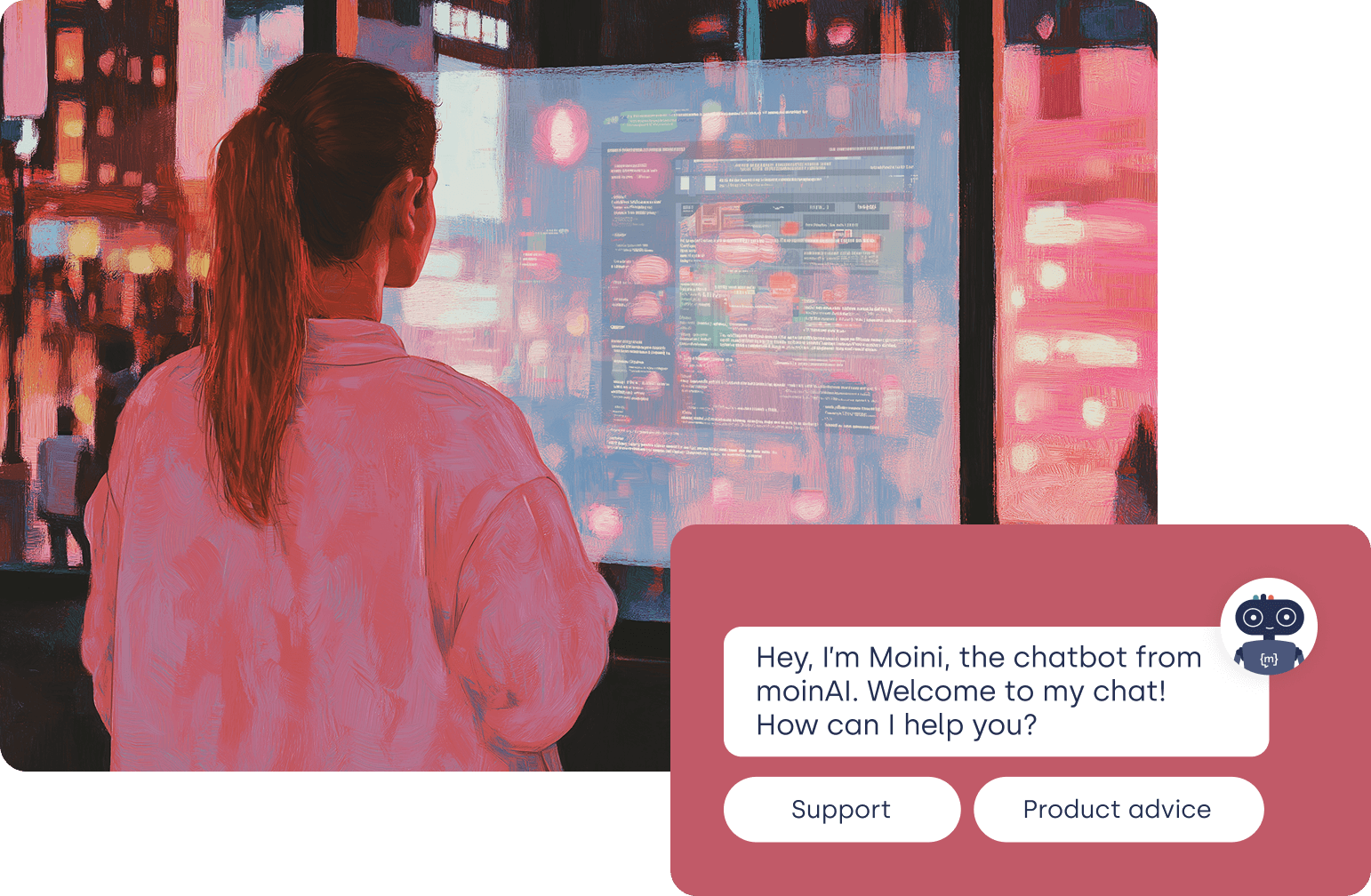
Chatbots are mostly used on websites, in apps or on messaging platforms such as WhatsApp – often with an avatar to visually accompany the conversation.
How does a chatbot work?
Modern chatbots are based on artificial intelligence. They understand user queries, recognise the underlying intention and generate appropriate responses – even to complex or unexpected questions. This is made possible by natural language processing.
Earlier chatbots operated on a rule-based system or were even purely keyword-based. They only responded to strictly defined keywords or precisely specified questions. Deviations in wording often meant that no suitable response could be found.
AI-powered chatbots are significantly more flexible. They can recognise contexts, hold conversations and communicate with other systems via interfaces (APIs), e.g. with a CRM such as HubSpot or a shop system. This allows for the provision of personalised information, checking delivery status or automatically updating data – all without any human intervention.
Some systems even go beyond traditional chatbots: AI agents take on entire areas of responsibility independently – for example, in product advice, customer service or handling recurring enquiries.
What types of chatbot are there?
Whilst early versions operated purely on the basis of rules or keywords, today’s systems are predominantly AI-powered. Chatbots have evolved significantly in recent years – both technologically and functionally. Depending on the area of application, objective and complexity, a distinction can still be made between various approaches:
- AI chatbots
- Specialised chatbots & AI agents
- Rule-based chatbots
AI chatbots
AI chatbots use artificial intelligence and natural language processing (NLP) to understand the intent and context of user queries. They are capable of processing natural language, responding flexibly and connecting to other systems via interfaces. AI chatbots are now the standard in professional applications.
Specialised chatbots & AI agents
Specialized chatbots and AI agents are advanced forms of AI chatbots. They take on entire areas of responsibility – for example, as product advisors in e-commerce or as automated service agents in the energy or insurance sectors. Particularly powerful variants utilise AI agent technologies that are trained for specific subject areas and operate autonomously.
Rule-based chatbots
Rule-based chatbots respond to predefined questions with fixed answers. They work reliably for simple, standardised processes, but cannot respond flexibly to new or complex enquiries. Due to their limited scalability, they now play only a minor role.
Smart chatbots or so-called AI chatbots are usually based on artificial intelligence (AI) and natural language processing (NLP). They recognize the customer's typed text and, thanks to NLP, understand the user's intention even behind complex and long sentences. NLP is used for the machine processing of natural language. The aim is to imitate an intelligent conversation, as if conducted by a human, using artificial intelligence. The NLP and AI-based chatbot, i.e. a free text bot, understands the natural language of humans and identifies the content according to the Word embedding, a technique from the field of NLP. The system looks at the sentence as a whole and then assigns a vector for each word. With comprehensive preparation and a targeted concept, the chatbot developed has a significant influence on the user experience (UX). The key aspects here are effectiveness, efficiency and positive customer feedback.
“Word embedding” and other NLP functions are certainly not familiar to everyone - understandably so. If you would like to learn more about this, please read the articles by Kai, the Head of AI at moinAI. Kai explains how NLP understands human language in a humorous, simple way using examples:
The advantages and disadvantages of chatbots with artificial intelligence
- Understand complex sentences and conduct dialogs
- Always keep track of the conversation and the context
- Ideal for an optimal user experience
- After development, usable on all platforms
- High savings potential through better efficiency in processes
- Build own database and constantly learn
- Provide data in real time
- High potential for generating insights
- Are available around the clock and answer customer queries effectively and quickly
- Cost-effective in the long run, as the acquisition costs quickly pay off through efficient automation
- See for yourself with the moinAI ROI calculators. Calculate your return on investment in customer service or marketing
- Initial programming causes high acquisition costs
- Not immediately usable
- Longer development time
What technologies underpin chatbots?
Modern chatbots use various AI technologies to process language, generate appropriate responses and interact with other systems. Different approaches are employed depending on the application. Let’s take a look at the key AI concepts behind chatbots:
Natural Language Processing (NLP)
NLP enables chatbots to understand and process natural language and respond appropriately. This means the system not only recognises individual words but also interprets whole sentences in context – including intent and relevant objects (entities).
Retrieval-Augmented Generation (RAG)
With this method, the chatbot combines pre-trained language model knowledge with information from a connected knowledge source, e.g. an internal database, FAQ page or product documentation. The result: well-founded, accurate and up-to-date answers.
AI Agents
AI agents are specialised, AI-driven units that independently handle entire areas of responsibility – for example, in customer service, product advice or internal processes. They are trained on specific topics, deliver consistent results and can be specifically controlled, monitored and optimised.
APIs and System Integration
By connecting to third-party systems such as CRM, ERP or e-commerce platforms, chatbots gain access to relevant data, e.g. customer numbers, order status or stock availability, and can thus provide personalised information or automate processes. This also prevents the chatbot from becoming a data silo.
Guardrails & Control Elements
To ensure that chatbots remain within the desired parameters, so-called guardrails are employed. For example, they detect when user queries are toxic, offensive or inappropriately worded – such as when coarse language is used in the context of a complaint – and ensure that the chatbot responds respectfully and in accordance with the rules, or terminates the conversation in a targeted manner.
Contextual understanding & memory
Modern systems are capable of taking previous messages into account during a conversation (‘context window’) or storing user behaviour (data protection must, of course, be observed here). This makes dialogues appear more natural, coherent and efficient.
What are the benefits of a chatbot?
A chatbot automates communication with customers, reduces the workload on internal teams and ensures faster response times – regardless of the time of day or the volume of enquiries. When used correctly, it improves the user experience, reduces costs and boosts efficiency in customer service, marketing and sales.
Key benefits at a glance
- 24/7 availability: A chatbot is online 24 hours a day, seven days a week, 365 days a year.
- Cost savings: Automated processes reduce the workload involved in customer contact, which in turn leads to lower costs.
- Increased efficiency: Many enquiries can be processed simultaneously and without human intervention.
- Better user experience: Chatbots help users find their way around and provide information directly.
- Higher customer satisfaction: Fast, reliable answers have a positive impact on the service experience.
- Scalability: As the volume of enquiries grows, the quality of responses remains consistent – without the need to build up new resources.
Nowadays, many people – particularly young people – prefer to submit their enquiries online. It’s quick, convenient and avoids waiting on hold. This is precisely where chatbots come into their own: they are available round the clock, respond immediately and can handle multiple enquiries simultaneously. In doing so, they relieve the burden on staff, reduce running costs and free up more time for complex tasks.
At the same time, they enhance the user experience by guiding users through content, providing information or assisting with forms. This quick, hassle-free support has a positive impact on customer satisfaction – especially when problems can be resolved immediately or questions answered straight away.

Where are chatbots used?
Chatbots can be used in almost every area of customer communication: from customer service and marketing to sales. Depending on the objective and process, they can take the pressure off teams, improve the user experience or boost conversion rates. However, the three most relevant areas are as follows:
- Customer service
- Marketing
- Sales
A chatbot in customer service
In customer service, chatbots automatically answer a wide range of recurring queries – quickly, reliably and around the clock. For users, it doesn’t matter whether a human or a system responds: what’s more important is that they receive help quickly. Chatbots meet this need even at three in the morning or on Christmas Eve.
As well as being used externally, chatbots can also be deployed internally – for example, on the intranet as a service assistant for staff. And should a bot ever reach a dead end, the conversation can be seamlessly handed over to a live chat or forwarded to support via email using a ‘human takeover’.
Benefits of a chatbot in customer service
- Reduces the workload on the support team through automated responses
- Lower costs and greater availability
- More time for complex issues
- Stable performance even during peak periods, e.g. on public holidays
→ You can find out more about chatbots in our article 6 Tips to Improve Response Time in Customer Service.
A chatbot in marketing
In marketing, chatbots ensure greater interaction and an improved user experience. They guide visitors through content, answer questions in real time and can be used for targeted campaigns, promotions or playful elements. This allows leads to be generated, qualified and addressed individually.
A chatbot can explain products, provide relevant recommendations or actively engage users in conversation. In e-commerce in particular, this can significantly boost conversion rates and engagement. Integration with social media channels also opens up further touchpoints for personalised communication.
Benefits of a chatbot in marketing
- Higher engagement on websites or social media
- Scalable lead generation and qualification
- Personalised user interaction in real time
- Positive effects on brand perception and willingness to buy
→ You can find out more about chatbots in marketing in our article Chatbots in Marketing: All the Information and Benefits.
A chatbot in sales
Chatbots also play an important role in sales – particularly in the early stages of the sales process. They identify potential customers on the website, analyse their behaviour and address them in a targeted manner. Intelligent forms allow information such as requirements, budget or timeframe to be captured in a structured way.
Enquiries can be forwarded directly to the CRM system, allowing the sales team to take over seamlessly. The chatbot ensures a quick initial response, pre-qualifies leads and paves the way for face-to-face meetings later on. Appointment scheduling with the sales team can also be automated.
Benefits of a chatbot in sales
- Automated capture and qualification of leads
- Reduced workload in appointment coordination
- Quick responses increase sales opportunities
- Better data foundation for the sales team
→ You can find out more about chatbots in sales in our article The Impact of AI on Sales.
How do I find the right chatbot?
The right chatbot solution depends heavily on the intended use and a company’s specific requirements. Is the chatbot intended to answer questions, automate processes, or actively guide users through content? Different technologies and configurations may be suitable depending on the objective.
Modern AI chatbots offer much more than just simple response logic. They can be specifically trained, connected to systems such as CRM or online shops, and even specialised for certain tasks – for example, as a product advisor or service assistant. Those who plan systematically and align the chatbot with the customer journey create added value for both customers and businesses alike.
To ensure you have the key pointers when searching for the right AI chatbot, we have created a checklist to simplify your research and highlight what you should consider when making your selection.
Checklist: What matters when it comes to a chatbot
- Clarify the objective: What is the chatbot supposed to do – relieve the support team, generate leads, provide advice, or even all of the above at once?
- Define the area of application: Will the chatbot be used in customer service, marketing, sales, or internally?
- Choose the technology: Is a standard AI chatbot sufficient, or would additional features such as Retrieval-Augmented Generation (RAG) or specialised AI agents be useful to better handle complex enquiries?
- Identify data sources: What information should the chatbot use? Is this data of good quality? The better the data is prepared, the more efficiently an AI chatbot can utilise it.
- Check system integration: Is integration with existing tools such as CMS, e-commerce platforms or CRM necessary? Which integration is most important? What would be a deal-breaker?
- Ensure scalability and future-proofing: Can the chatbot be scaled up as demand grows? Is billing per conversation, or is there a flat-rate model that doesn’t make the chatbot’s success more expensive?
- Consider language & target audience: Does the chatbot need to support multiple languages or communicate in industry-specific terms? Are different channels required, as the approach varies depending on the target audience?
- Consider data protection and security: Is the solution GDPR-compliant and does it protect sensitive user data? Is it hosted within the EU?
- BFSG compliance: Is the chatbot accessible? For example, the chat widget should be screen reader-compatible, offer sufficient contrast, and be able to provide alt text for images.
- Ensure evaluation and analysis: Is there a user-friendly dashboard for evaluating chats, identifying potential, and implementing targeted optimisations?
Conclusion
If you want to communicate successfully today, there’s no getting around AI chatbots!
Chatbots are no longer simple question-and-answer systems. Behind the chat window lies highly advanced AI technology that understands language, automates processes and creates powerful user experiences. What sounds complex is easy to use with moinAI – without any technical prior knowledge or a long lead time.
Getting started is easier than you might think: with moinAI, you can create your first chatbot prototype in just a few steps – free of charge and with no obligation, of course.
Happier customers through faster answers.
See for yourself and create your own chatbot.
Of course, for free and without any obligation.
