


The chatbot solutions available on the market vary greatly; some are highly specialised in specific areas and offer a wide range of functions. There are various types of chatbot: rule-based chatbots, AI-based chatbots, digital assistants, voice bots and hybrid chatbots. This article focuses on the latter, which combine several types of chatbot into a single solution.
What Is a Hybrid Chatbot?
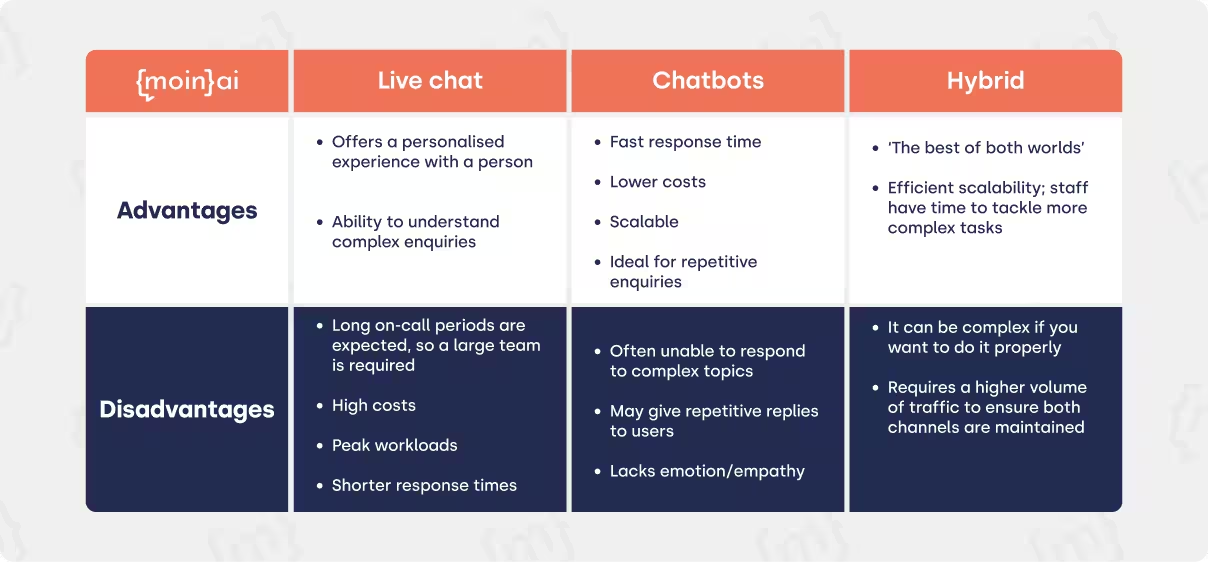
Just as a hybrid car is an electric vehicle that can also draw on an internal combustion engine, hybrid chatbots also combine several forms of dialogue: this means it is possible to have a conversation with a chatbot in the traditional sense – that is, dialogue software that is often based on artificial intelligence – as well as a conversation with a human via live chat. Both forms of dialogue take place within the same chat window (widget), ensuring that the transition from a human to a chatbot (or vice versa) is seamless, making the experience pleasant and straightforward for the user. Incidentally, the handover from the chatbot to a live chat agent is known as a ‘human takeover’. In a hybrid chat, the motto is therefore not “chatbot vs. live chat”, but “live chat & chatbot – the ideal combination”.
What Are the Benefits of a Hybrid Chatbot?
A hybrid chatbot combines the best of both worlds. It offers users human contact when necessary. This is particularly useful, for example, when users are very upset or frustrated, have a highly complex enquiry, or require individual and personalised advice from an expert. At the same time, a hybrid chatbot offers the benefits of automated customer communication: it provides a 24/7 point of contact for users and customers – because even when live chat agents have finished work for the day, the chatbot remains online and is available to all users.
Furthermore, the chatbot takes the pressure off live chat agents, as not every question that reaches a live chat agent needs to be answered by them. In fact, 80 per cent of enquiries are recurring, meaning that an automated response (from a chatbot) would be entirely sufficient, and human contact would only be required in complicated cases.
So, if a chatbot is deployed as the first point of contact, it can answer recurring questions in a matter of seconds whilst simultaneously pre-qualifying enquiries – that is, identifying the user’s issue and forwarding this information, along with the contact details, to a live chat agent. The chatbot acts, so to speak, as a firewall that ‘lets through’ or forwards enquiries that require assistance from a member of staff.
This is particularly worthwhile during peak periods. Whether it’s in e-commerce during the Christmas rush or at gyms at the start of the year: at certain times, enquiries pile up, making it very difficult for the customer service team to keep up with providing prompt responses. If a live chat service is offered in such situations, it is often not possible to staff it adequately on a permanent basis. However, the combination of live chat and a chatbot can work perfectly in these situations.
A Practical Example of a Hybrid Chatbot
Many companies now rely on a combination of human staff and artificial intelligence, using a hybrid chatbot to provide expert assistance to (potential) customers and users at all times. One such company is BLS, the Swiss standard-gauge railway operator, whose services include travel by train, bus, boat and car transport. BLS operates an extensive network and therefore receives a large number of enquiries every day.
Initial Situation
Michael Rieder (Application & Knowledge Manager, Customer Care Center BLS) explains the decision to combine live chat and a chatbot in the moinAI webinar as follows:
It is important to be aware of the nature of the contacts and interactions you have with your customers. If you analyse this a little, you will see that there are very different kinds of interactions – not only in terms of content, but also in terms of their nature. For example, there are those that are desired by both sides, and those that are not particularly interesting from the company’s point of view, and where customers themselves say, ‘It isn’t necessary for me to communicate with the company personally.’

The latter are usually simple, recurring queries where a brief piece of information is sufficient – whether it is provided by a service agent is secondary. The priority is that the question is answered quickly and correctly – and in most cases, a chatbot can provide this. For customers, this has the advantage of receiving an answer to their question around the clock and very quickly. For the company, in this case BLS, it means that customer service staff have more time for complex issues and no longer have to "struggle" with recurring and simple questions.
It was also important for BLS never to make it difficult to get in touch:
We are deliberately very keen to engage with our customers, because we can learn from them; a customer can highlight a blind spot that we are unaware of. It was therefore important for us not only to have a chatbot solution, but also to be able to communicate seamlessly via a live chat tool.
Solution
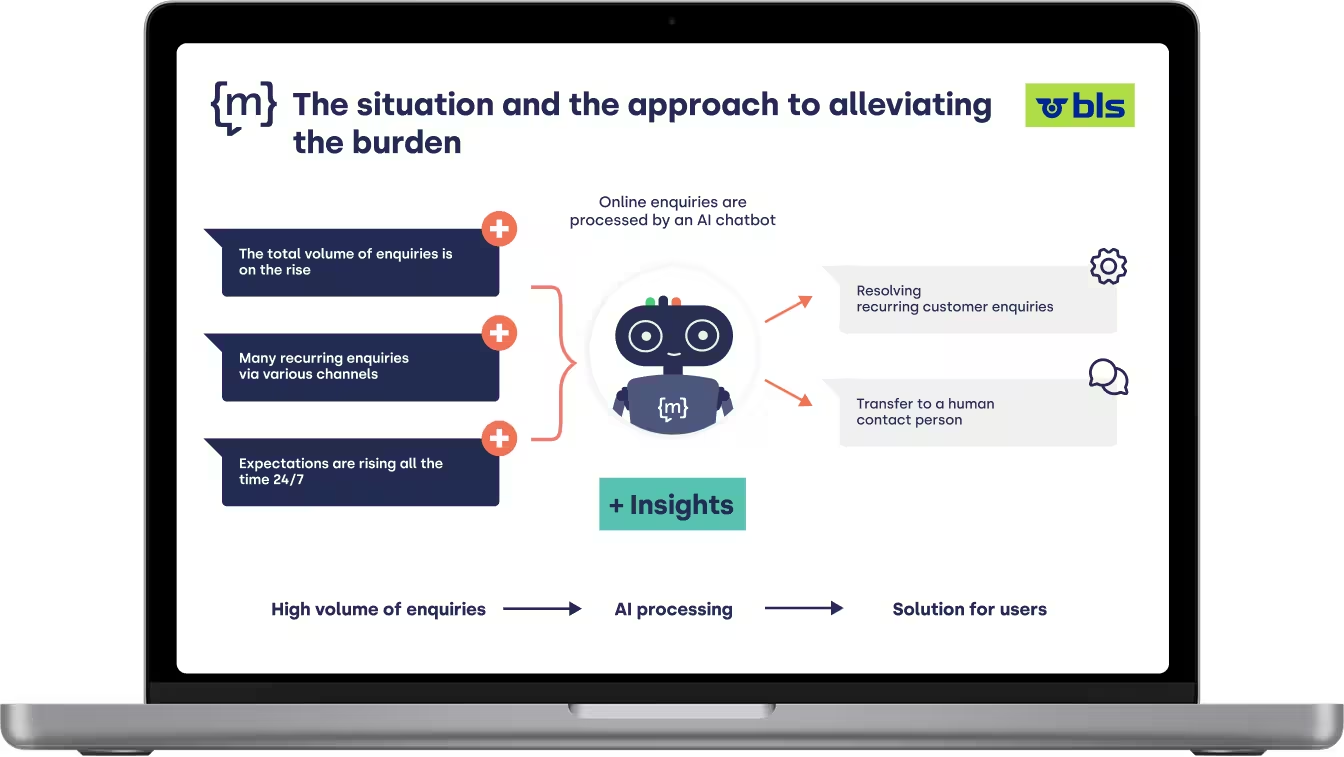
Factors such as the coronavirus pandemic, the increased use of smartphones, and digitalization in general mean that users and customers expect a company to provide answers around the clock and as quickly as possible. At the same time, the number of inquiries is rising, and a large proportion of customer requests are recurring.
Another challenge: BLS has set itself the goal of providing an answer to incoming questions within one hour – however, this cannot be achieved solely with live chat agents, who are naturally not present and available 24 hours a day.
All these factors and challenges can be ideally overcome with an AI-based supplement – in the form of a chatbot. This is also shown in the following diagram, which describes the challenges and the solution path.
Successful Launch and Next Steps
"Things get really exciting after the chatbot is launched," explains Michael Rieder. This allows you to not only see the performance of pre-determined topics but also to recognize what users are asking about outside of those known topics. moinAI clusters these insights and suggests them to BLS (Dreaming feature).
"You learn a great deal about the additional topics customers are bringing up that hadn't previously come in as tickets" – Michael Rieder. Based on these clustered AI suggestions, BLS was able to continuously add topics to the chatbot that were previously unknown or not highly prioritized – but which were deemed important due to active user demand.
Results:
After just two months, BLS has already achieved impressive results with the chatbot:
- The automation rate is 86%. This means that the chatbot automatically answers 86% of incoming messages, with only the remaining 14% requiring assistance from a staff member.
- Chatbot responses are rated positively in 81% of cases. The chatbot requests feedback at the end of every conversation to see how helpful the response was.
3 Tips: What Should You Keep in Mind?
Customers want personal and engaging interaction. We are familiar with it from our private lives and now from the workplace – we are used to connecting with others quickly and easily. Nowadays, this often happens via chat, and the reasons are obvious: messenger services are easy to use, a dialogue can be started and finished in no time, and a response usually doesn't take long. We are accustomed to this in our private lives and have come to expect it, but this trend is now making its way into the professional world as well. For companies, accessibility is a key factor for success. “We have all become world champions at chatting” – Björn Bauer.
According to Björn Bauer (Senior Manager Solution Consulting, Zendesk), it is important to always prioritize the customer's perspective. Companies must make interaction as simple as possible for customers. The main question is therefore: Are the steps a customer has to take to interact with the company easy to manage and easy to understand?
It should be ensured that this is simple not only from the company's perspective, but above all from the customer's point of view. “And that is exactly where BLS [using live chat and AI chatbot] has taken decisive steps that make it easy for customers to get in touch with them.” – Björn Bauer (Zendesk).
Engage customers in a context-aware manner. Using a teaser, a chatbot can welcome website visitors with a short message and suggest topics directly via buttons. These topic buttons can and should change from page to page – and that is exactly how BLS handles its teaser configuration. Depending on the page, the user is greeted with a tailored teaser.
How Does the Transition from Chatbot to Live Chat Agent Work?
As mentioned above, this transition is known as ‘human takeover’ or, in some contexts, ‘human handover’.
From the customer's perspective, the transition is very straightforward. The customer remains in the same context and the same chat window. They simply need to wait a moment for the chatbot to hand over to the agent to receive a response.
But what does it look like "behind the scenes"? In other words, when a company like BLS uses Zendesk as a live chat tool and moinAI as a chatbot solution?
Thanks to APIs, moinAI can be easily connected to almost any live chat software, allowing companies to fully leverage the benefits of a hybrid chatbot solution. This video shows what the user interface for live chat agents looks like in practice and how they can take over the conversation from the chatbot and then hand it back.
Hybrid Chatbots in Practice – 2 Solutions, 1 Chat Window
Most solutions, both chatbots and live chat, offer a chat window/widget that appears on a company's site once the respective solution has been integrated. These widgets are generally fully customizable: you can define headlines, sub-headlines, an avatar, and the color scheme, among other things. Another advantage is that, thanks to APIs, it is possible to use both technologies while combining them into a single widget. For example, some companies display live chat and a chatbot within the Zendesk widget. Others choose the moinAI widget and display their live chat solution (e.g., Zendesk, Userlike, or LiveChat) within it.

Conclusion: Promising Collaboration Between Humans and AI
Hybrid chatbots have the advantage of being able to respond to a wide variety of user enquiries. They are therefore a key tool for providing good customer service, as customer service teams often have to deal with a wide range of questions and concerns. Hybrid chatbots help to save time and effort in day-to-day work, whilst also optimising customer satisfaction and service levels in the long term.
A hybrid chatbot offers the best of both worlds, combining the convenience and user-friendliness of an intelligent personal assistant with the adaptability of a rule-based chatbot and the learning capabilities of AI – this solution is perfectly complemented by the option of integrated live chat with a service representative.
[[CTA headline="The future of your customer service is hybrid" subline="Enter your website and discover how humans and AI work together perfectly."]]


