
.avif)

Why is AI so important for a chatbot?
AI gives the chatbot a form of intelligence. It is only thanks to AI that a chatbot is able to understand complex messages, categorise them under the correct topic and thus provide the correct response. Furthermore, a chatbot can only learn independently and develop on its own if it is AI-based. There are, of course, many features and benefits that arise from AI. One of these features is ‘Dreaming’.

What is Dreaming?
A common criticism of chatbots is that, beyond the knowledge they have been trained on, they understand very little and are therefore unable to process or even reflect on unfamiliar content. This is not the case with moinAI. Thanks to ‘Dreaming’, moinAI is able to process content and user enquiries that go beyond the knowledge it has learnt.
Behind the ‘Dreaming’ lies what has now become a proper night shift:
- Whilst you are offline, specialised AI agents on the moinAI platform get to work for you, gathering a cross-section of genuine user enquiries from the past few days.
- The AI then uses semantic embeddings to group similar phrases into topic clusters and automatically refines these clusters. This process continues until the topics are clearly defined. Language, typos or the exact wording are irrelevant.
- Finally, another agent reviews each topic just like a human analyst would: it filters out outliers, merges duplicates and assigns a clear name to each topic.
- In the morning, the results are ready and organised in your dashboard, without you having to read a single conversation manually
Today, Dreaming goes beyond simply identifying new, unknown topics. The AI agents provide four types of insights: Topic Insight, a recurring topic that no agent in the chatbot currently covers; Knowledge Insight, where the correct agent is responsible but lacks the knowledge to provide a good response; Quality Insight, where an answer to a topic already exists but is rated noticeably negatively by users; and Structure Insight, i.e. a topic is spread across several agents.
Every insight identified is suggested to the chatbot owner – that is, the company using the chatbot – within the Hub. This includes context relating to the relevant conversations, the agents involved and real-life example queries. Ultimately, it is always the company that decides which insight to implement.
Best Practice: Examples of moinAI clients
The following examples illustrate how this works in practice. They are representative of ‘Topic Insight’ – that is, when the AI agents identify a recurring topic for which no agent is yet assigned within the chatbot.
- Expansion of product ranges by a window manufacturer
The AI chatbot is now being trained on various topics; in the case of the window manufacturer, these include, for example: “Get a quote”, “Warranty”, “Costs” and “Window sizes”. These topics were selected by the company as they are the ones about which customers and prospective clients ask questions most frequently. Within a few days, several customers ask the same type of question in the chat: they quote a specific window code and want to know the corresponding dimensions or spare parts. Taken individually, these enquiries appear to be isolated cases, but the nightly analysis reveals that there is a recurring pattern behind them. Dreaming groups the enquiries under a common topic, provides suitable sample responses straight away, and suggests creating a dedicated agent for this purpose – rather than the team only noticing the cluster by chance whilst reviewing a sample of the enquiries. - Expansion from a customer service case to a marketing and sales case at an insurance company
A second scenario could be illustrated using an insurance company as an example. The insurance company has integrated the chatbot into its customer service to reduce the volume of support enquiries. The chatbot has been trained to handle topics such as ‘reporting a claim’, ‘login problems’, ‘changing names’, etc. These are exclusively service-related issues designed to assist existing customers. A specific case – such as a question about a particular supplementary insurance policy – appears over several weeks in slightly different phrasing: sometimes as a direct question, sometimes in more general terms. Because the AI agents cluster by meaning rather than by keywords, Dreaming nevertheless recognises that these are all the same enquiry and groups the queries together under a single topic. This makes it clear that it is worthwhile to build up targeted knowledge for this specific case, rather than continuing to answer each enquiry individually. - A better understanding of customers in the publishing industry
Another example of the Dreaming feature is the AI chatbot developed by the publisher Spektrum der Wissenschaft, which is actively used in practice to generate and process customer insights. Spektrum’s chatbot is deployed on the subscription landing page and was initially trained to handle standard questions, such as “What’s included in the subscription?” or “When is the next issue due out?”. Some time after the chatbot was implemented, other user queries began to emerge that the chatbot had not yet been trained to handle. Customers are increasingly enquiring about a new additional service that has only recently been introduced and which has not yet been programmed into any agent. As the topic is new and still relatively minor, it would easily get lost in the mass of daily conversations. Dreaming, however, recognises the cluster of enquiries at an early stage, classifies it as a separate, new topic and thus highlights that a need is emerging here, even before the enquiries turn into a veritable flood.
This is what Dreaming looks like in the Hub
All the results of the analysis are compiled in your Dreaming dashboard in the Hub, clearly organised by week and easy to see at a glance:
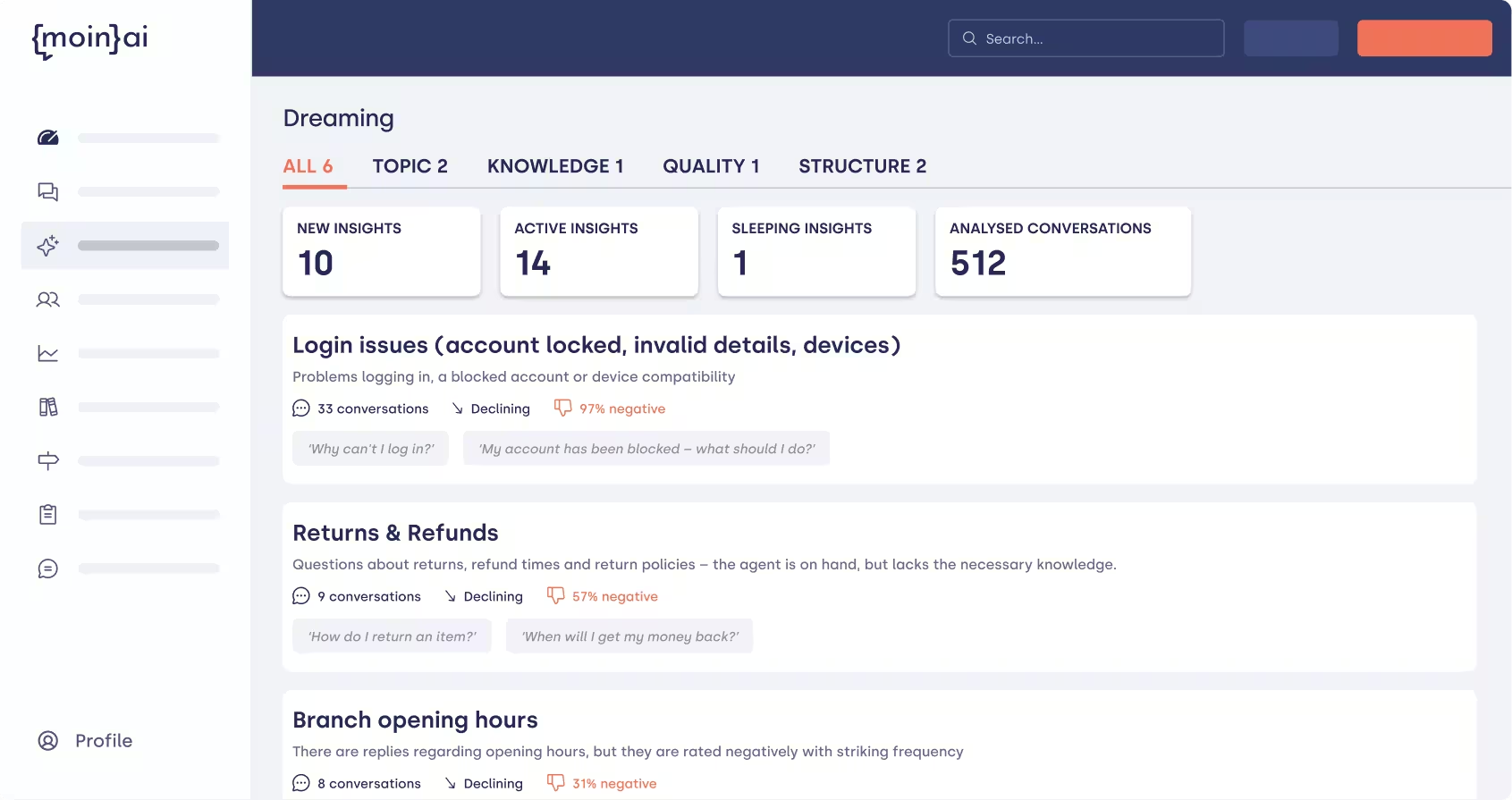
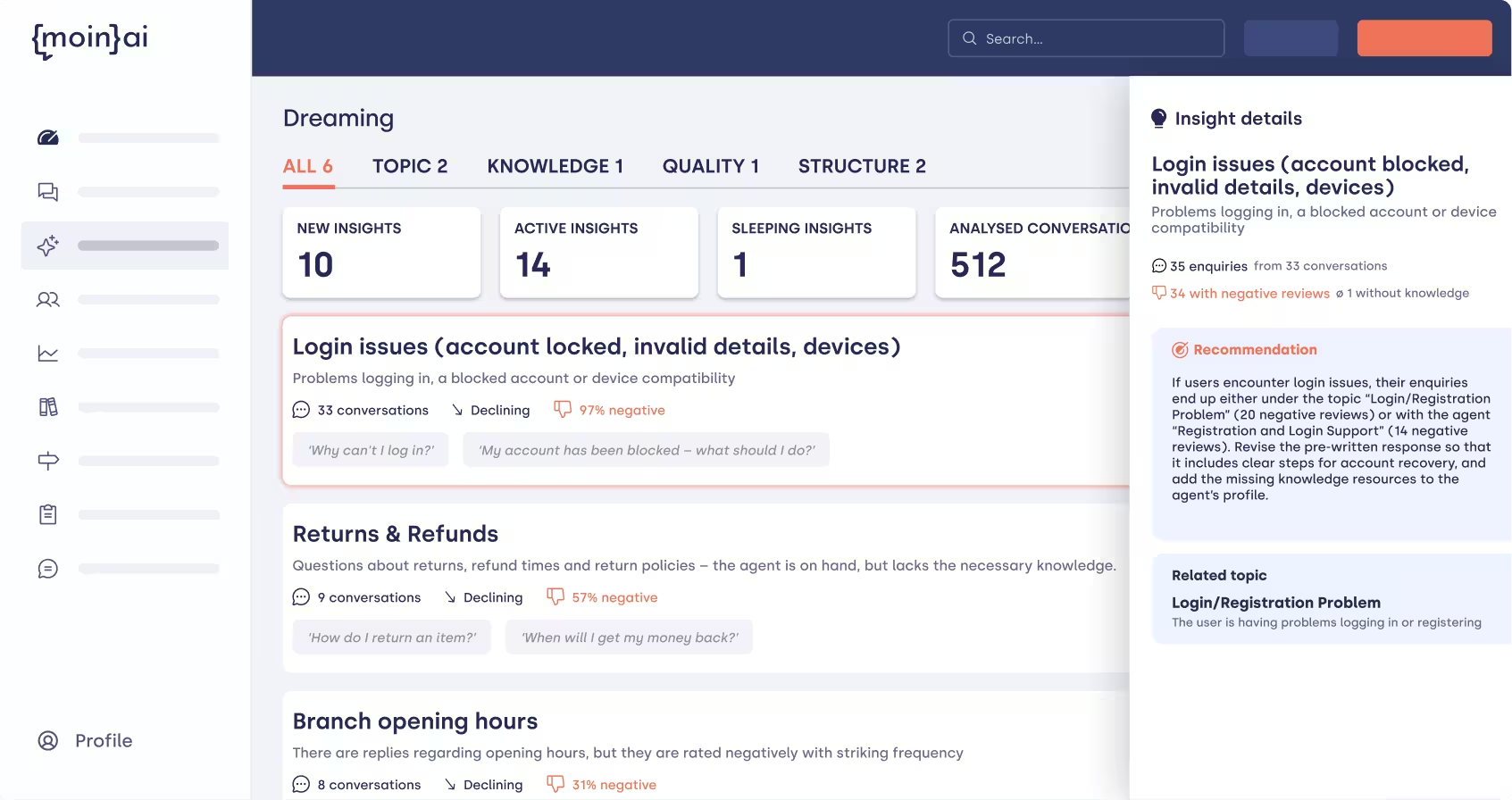
At a glance, you can see how many conversations have been analysed, how many new insights have been added, how many are currently being actively processed, and how many are ‘dormant’ – in other words, no longer relevant. Filters allow you to quickly narrow down the type of insight you wish to view: Topic, Knowledge, Quality or Structure. Each individual insight is displayed as a separate card and provides the context needed to make a decision: the number of conversations affected, the agents involved and, depending on the insight type, the knowledge rate or the proportion of negative ratings.
Ultimately, it’s always you, the customer, who decides what happens with your insight: create a new topic, fill in any gaps in knowledge, or improve an existing answer. Dreaming provides the insight; it’s up to you to put it into practice!
How often does your company gain new insights?
The AI agents generally analyse your conversations every week; the nightly analysis runs continuously, regardless of the package you have booked. How often you actually see the ready-to-use insights depends on the specific pricing package: in the Business package, the insights report is published quarterly; in the Professional package, it is published monthly and can be switched to weekly if required. In the most comprehensive package, the insights are available weekly from the outset – ideal for businesses with a high volume of conversations where topics change rapidly.
Dreaming can therefore be tailored to your actual needs: if you tend to make strategic decisions based on the insights only occasionally, a quarterly overview will suffice. On the other hand, those who continuously update their chatbot knowledge will benefit from the weekly release.
Privacy and security at Dreaming
Precisely because Dreaming analyses thousands of customer conversations automatically and without human intervention, data protection plays a central role. moinAI is firmly committed to European standards: the platform is developed and hosted in Hamburg, and all data processing is carried out in accordance with the GDPR on servers within the EU. The AI model used for semantic analysis is also proprietary and hosted within the EU. No customer data is therefore transferred to third-party providers outside Europe.
Companies can therefore use Dreaming without having to reconsider data protection issues every time they carry out an analysis. Control remains with the company itself.
More insights and knowledge about what really matters to users and the target audience
moinAI’s Dreaming feature has one clear advantage above all else: it reveals more to the company about what users really want and expect. By not only collecting but also intelligently clustering topics that the chatbot is not yet able to handle, the AI provides companies with fascinating insights into their users.
Through ‘Dreaming’, the chatbot’s AI is able to use analysis and self-reflection to identify what else interests users and which topics the chatbot should be expanded to cover, in order to further improve the user experience. The AI chatbot thus gets to know the target audience or website visitors as well as possible, gradually exploring new subject areas and, at the same time, adapting to users’ wishes and needs.
[[CTA headline="Understand what your users really want with moinAI" subline="Our chatbot generates insights that the human eye often misses. Discover your website’s potential for automation now." placeholder="Insert your company URL here" button="Try it now!"]]


